
 SetPaying for Seoul transport
 Hi, I’m SeoulAslan
Seoul Subway Basics for First-Timers (2026)
Checked Sept 29, 2026
The Seoul subway is easy once you know four things. Lines have a number and a colour. Every station has a number. You tap a transit card at the gate going in and again going out. And the exit number decides where you come up. An adult ride costs 1,550 won with a T-money card, or 1,650 won with a single ticket plus a 500 won deposit you get back.
Before any trip abroad I look up the same short list: does cash work, how do the ticket machines work, do cards work, can I just tap, and where do I buy a pass. I picked that habit up in about six years of living in Vietnam. This post is that list for the Seoul subway.
Jump to: Lines and colours · Station numbers · Exit numbers · Paying at the gate · Transfers · Line 9 express · First and last trains · Seats · FAQ
How do Seoul subway lines and colours work?
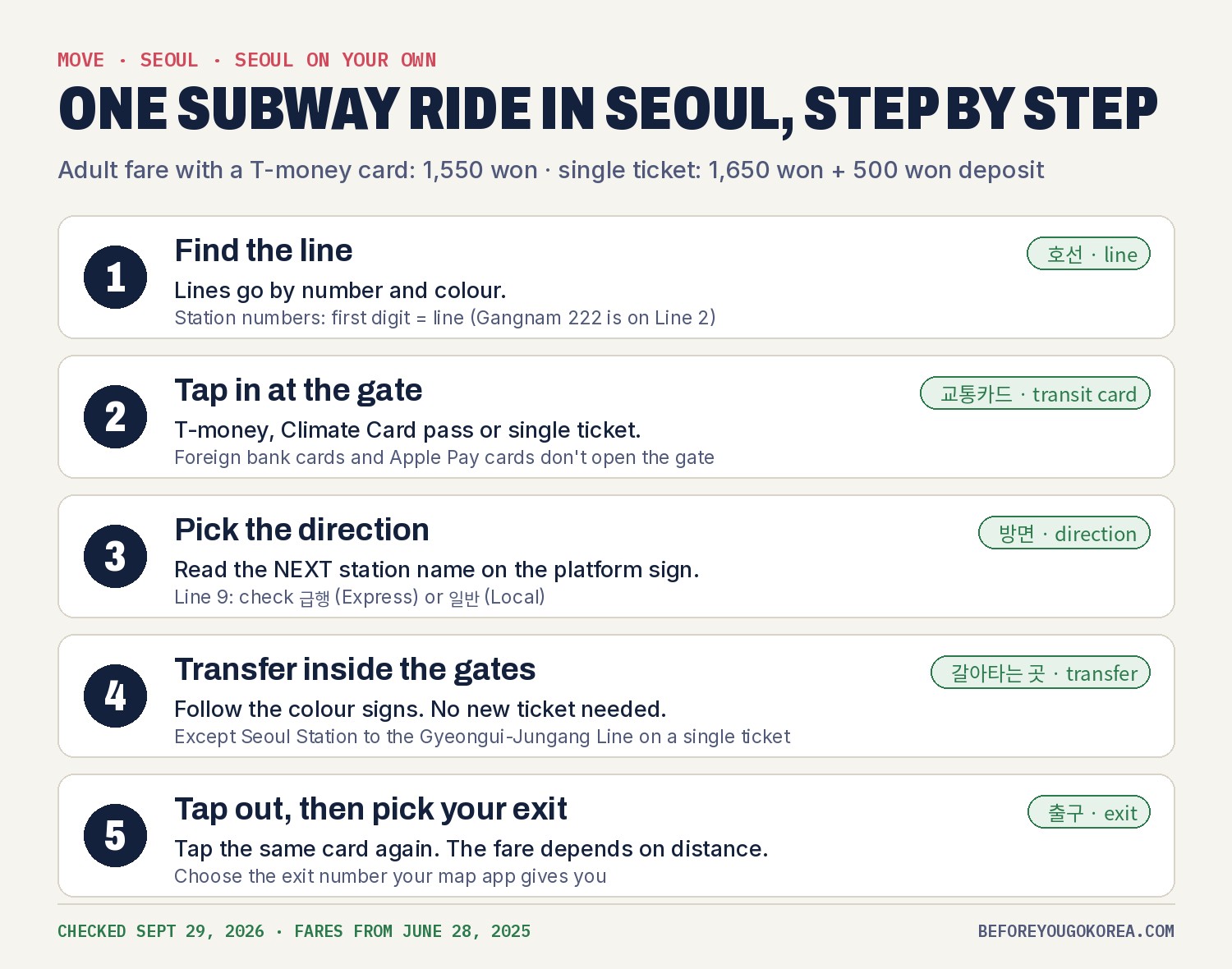
The core of the network is Lines 1 to 9. Each has a colour, and the colour is on every sign, map and platform. Once you know your line's colour, you can follow it through a big station without reading anything.
| Line | Colour | Korean |
|---|---|---|
| Line 1 | Dark blue | 1호선 |
| Line 2 | Green (a loop around the city) | 2호선 |
| Line 3 | Orange | 3호선 |
| Line 4 | Sky blue | 4호선 |
| Line 5 | Purple | 5호선 |
| Line 6 | Brown | 6호선 |
| Line 7 | Olive green | 7호선 |
| Line 8 | Pink | 8호선 |
| Line 9 | Gold | 9호선 |
| Airport Railroad (AREX) | Sea blue | 공항철도 |
| Gyeongui-Jungang Line | Jade | 경의·중앙선 |
| Suin-Bundang Line | Yellow | 수인·분당선 |
| Shinbundang Line | Red | 신분당선 |
Several companies run these lines, but one transit card works on all of them. A few lines cost more than the base fare. The Shinbundang Line to Pangyo is one of them.
Direction: platform signs show the next station and the end of the line. Read the next station name, not just the end station. That matters most on Line 2, which runs in a loop, so both platforms can reach the same place.
What do the station numbers mean?
On Lines 1 to 9, each station has a three-digit number, and the first digit is the line. Gangnam, for example, is 222 on Line 2. The other lines use a letter and a number instead.
Station numbers help when you can't read the Korean name or when two names look alike. A transfer station has one number for each line it serves, so don't worry if the number changes when you change lines.
Why do exit numbers matter so much?
Big stations have many exits, often on both sides of a wide road. Gangnam's exits go up to number 12. Come up the wrong one and you can be a long, busy crossing away from where you meant to be.
That's why Koreans give directions as "Exit 3 of this station" (3번 출구). Naver Map and Kakao Map tell you which exit to take. Pick it before you tap out, then follow the exit signs (출구 Exit).
If you have a big suitcase or a stroller, check which exit has an elevator. Not every exit does.
How do I pay and get through the gate?
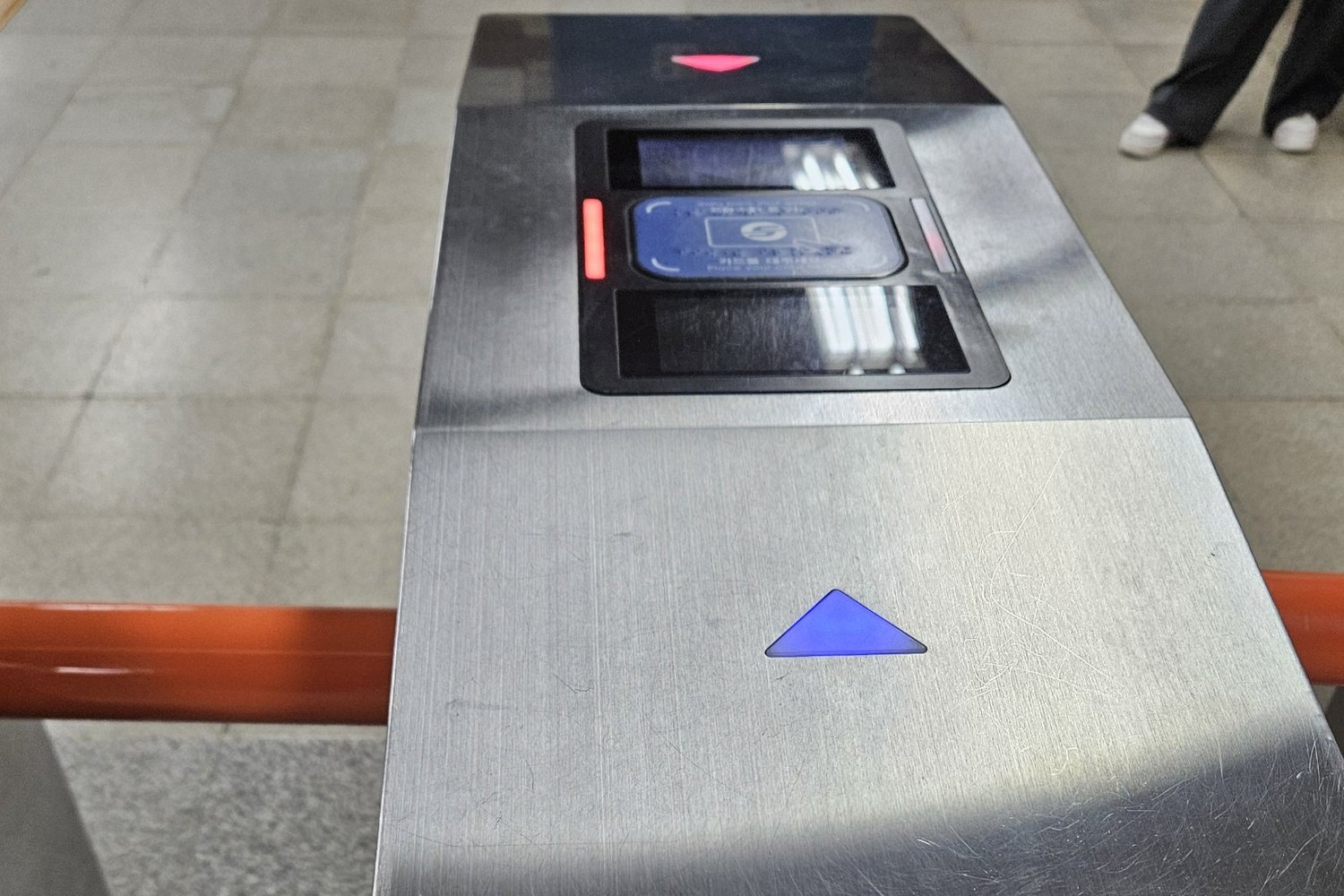
Hold your card flat on the round reader until the gate beeps and opens. Do the same on the way out. The subway charges by distance, so the gate works out your fare when you leave.
Three things open the gate:
- A T-money card (티머니). Buy one at a convenience store or a station, and top it up with cash.
- A Climate Card tourist pass (기후동행카드 단기권). Unlimited rides in Seoul for 1, 2, 3, 5 or 7 days, from 5,000 to 20,000 won, plus 3,000 won for the card.
- A single-journey ticket (1회용 교통카드). One ride, bought at a station machine.
A foreign Visa or Mastercard won't open the gate, even in Apple Pay. I cover that, and what changes in 2027, in Can you tap a contactless card on Seoul transit?
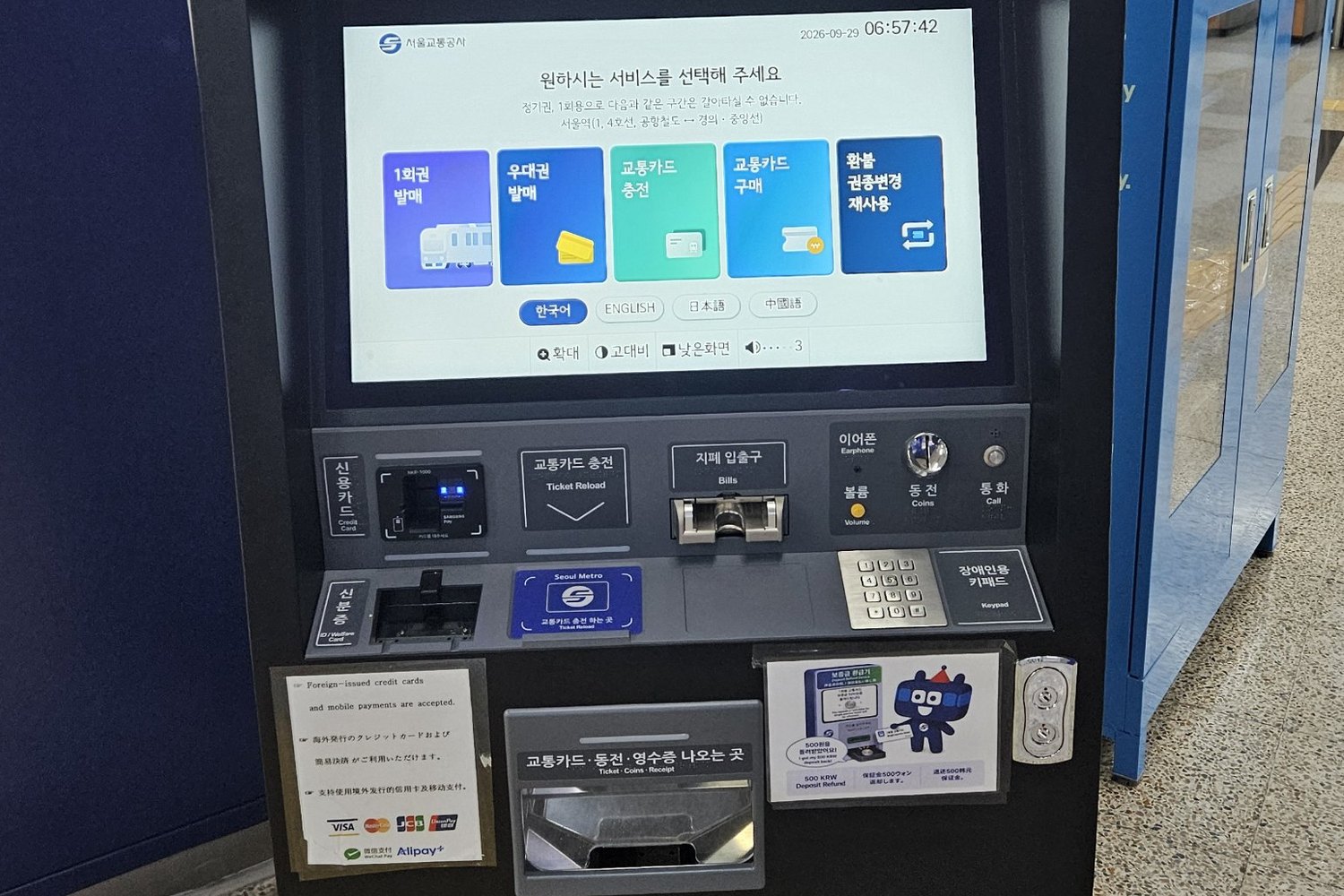
I photographed these machines at two Seoul subway stations on Sept 28 and 29, 2026. The new kiosks have an English button and take foreign cards for single tickets and Climate Card passes. The city says there's a fee of about 3.7%. Topping up an ordinary T-money card is still cash.
| Who | Transit card (T-money) | Single ticket |
|---|---|---|
| Adult | 1,550 won | 1,650 won + 500 won deposit |
| Teen (13–18) | 900 won | Not confirmed |
| Child (6–12) | 550 won | Not confirmed |
That's the base fare for up to 10 km. After that you pay 100 won more for every 5 km, and past 50 km, 100 won for every 8 km.
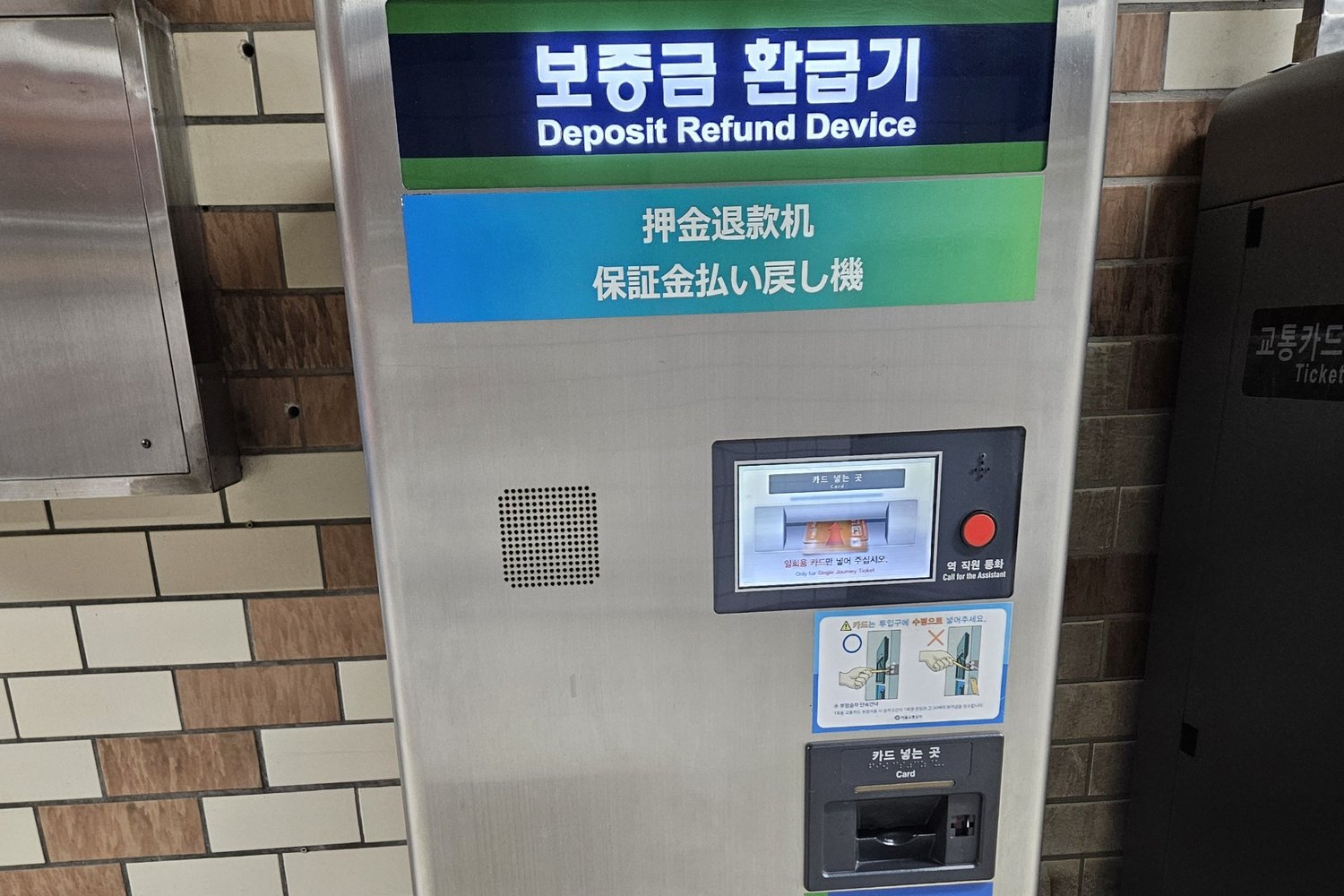
Get your 500 won back. A single ticket is a plastic card with a 500 won deposit. After you tap out, look for the 보증금 환급기 (Deposit Refund Device) near the gates and insert the card.
How do transfers work?
Almost all subway-to-subway transfers happen inside the gates. Follow the signs that say 갈아타는 곳 (Transfer) in the colour of your next line. You don't tap or pay again.
Subway to bus works too, with a transit card. Tap out, and board the bus within 30 minutes, or 60 minutes between 9 pm and 7 am. You can link up to five rides in one trip. You pay for the extra distance, not a new base fare.
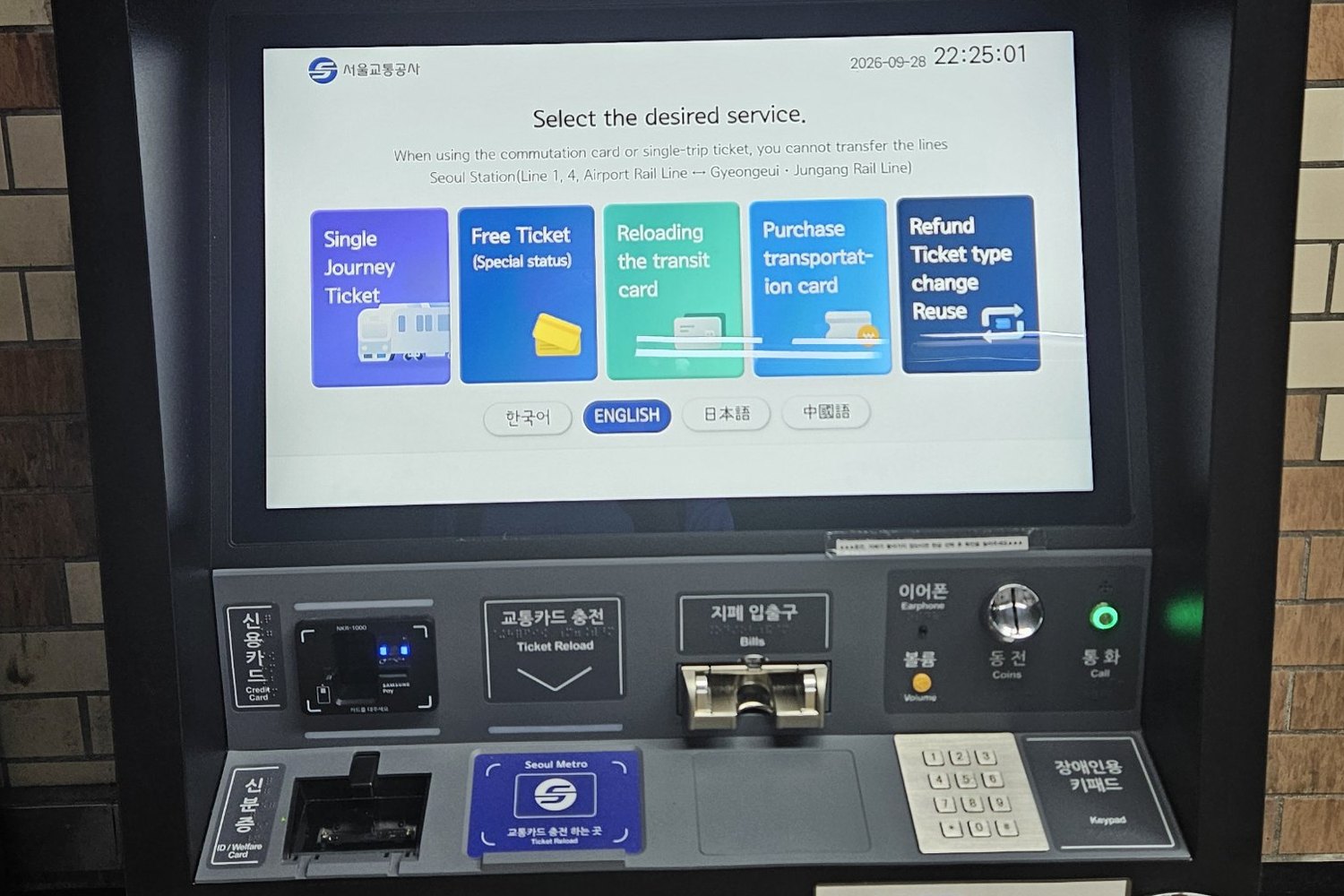
The Seoul Station catch. The kiosk screen above says it plainly: with a single-trip ticket or a commuter pass, you can't transfer at Seoul Station between Line 1, Line 4 or the Airport Railroad and the Gyeongui-Jungang Line. That line has its own gates in a different part of the station. On a single ticket, you'll have to buy another one.
The machine also tells you where the buttons are. The card slot is labelled 신용카드 (Credit Card), the reload pad is 교통카드 충전 (Ticket Reload), and the bill slot is 지폐 입출구 (Bills).
What is the Line 9 express, and should I take it?
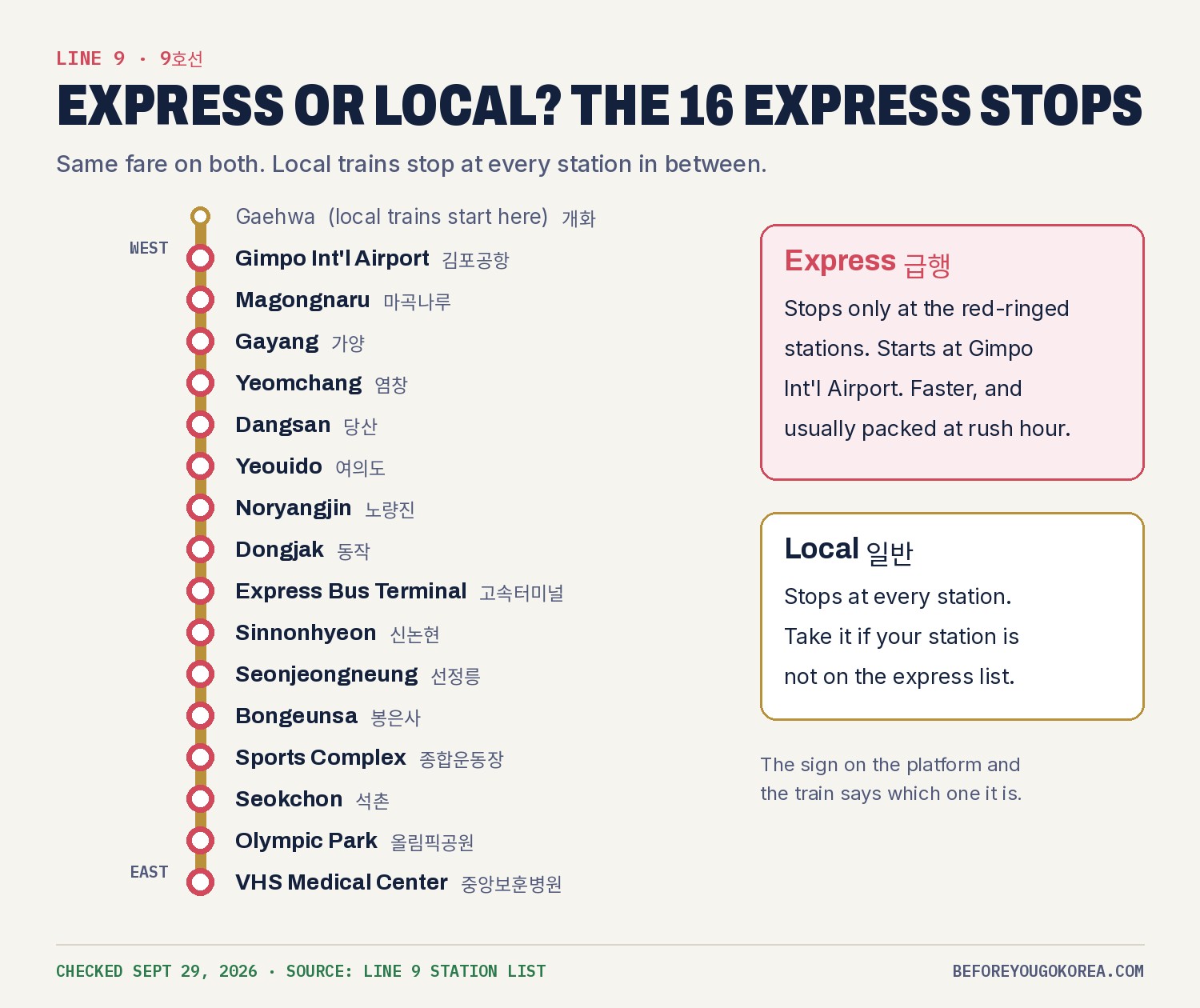
Line 9 runs two kinds of trains on the same tracks. Express trains (급행) stop at 16 stations. Local trains (일반) stop at all of them. The fare is the same.
If your station is on the express list, the express saves real time, for example between Gimpo Airport, Yeouido, Express Bus Terminal and the Gangnam area. If it isn't, an express will carry you straight past it. Check the sign on the platform and on the train before you get on.
The express is also known for being very crowded at rush hour. With a big suitcase, a local train is often easier.
What time is the first and last train?
On Lines 1 to 8, first trains leave at around 5:30 am. Last trains reach the end of the line at about 1 am on weekdays and about midnight on weekends and public holidays. The last train from your station leaves earlier than that, so check it in your map app, where it's marked 막차 (last train).
In May 2025 the city announced it would move first trains on Lines 1 to 8 to 5:00 am and last trains 30 minutes earlier, possibly from August 2025. As of December 2025, reports of a planned strike still gave the first train as 5:30 am. I found no report that the change has happened since, but I couldn't check an official timetable. Look at your station's timetable if you have an early flight.
If you miss the last train, Seoul has 14 night bus routes whose numbers start with N. They run from 11 pm to 6 am and cost 2,500 won with a card. Or take a taxi. For taxis, see Can you use Uber in Korea?
Where can I sit? Priority seats and pink seats
- Priority seats (교통약자석) are at both ends of each car. They're for older people, people with disabilities, pregnant women, people with small children and children. Seoul Metro says older cars have 12 per car and new cars 8.
- Pink seats are for pregnant women (임산부 배려석). Leave them empty unless that's you.
- The Seoul subway has no women-only cars. The pink seats are not one.
Korean words on subway signs
| English | Korean | Where you'll see it |
|---|---|---|
| Exit | 출구 | Yellow signs to the street |
| Transfer | 갈아타는 곳 | Signs to other lines |
| Express / Local | 급행 / 일반 | Line 9 platforms and trains |
| Single-journey ticket | 1회용 교통카드 | Ticket machines |
| Deposit refund machine | 보증금 환급기 | Near the gates |
| Top up a card | 교통카드 충전 | Ticket machines ("Ticket Reload") |
| First train / last train | 첫차 / 막차 | Timetables and apps |
| Priority seats | 교통약자석 | Both ends of each car |
| Seat for pregnant women | 임산부 배려석 | Pink seats |
FAQ
How much is the Seoul subway fare in 2026?
1,550 won for an adult with a transit card, 1,650 won with a single ticket, for the first 10 km. Those prices started on June 28, 2025.
Do I have to tap out on the Seoul subway?
Yes. The fare depends on distance, and the gate won't let you out without a tap.
Can I pay cash at the subway gate?
No. Use cash at the ticket machines to buy a single ticket or top up T-money, then tap at the gate.
Is the Line 9 express more expensive?
No. Express and local trains cost the same. The express just skips stations.
What does the "모두의카드" or "기후동행패스" poster at the machines mean?
Those are fare-discount schemes for people who live in Korea. 기후동행패스 is the Seoul-resident version, launched on September 1, 2026, and only Seoul residents get its benefits. For visitors, nothing changes: the Climate Card tourist passes for 1 to 7 days are staying. The 30-day Climate Card ends on October 1, 2026.
Things I could not confirm:
- Whether first trains on Lines 1 to 8 have moved from about 5:30 am to 5:00 am since the 2025 announcement. I found no report that they have.
- Exact last-train times for 2026. The weekday 1 am and weekend midnight pattern comes from the 2022 return of late-night service.
- Whether the older ticket machines, like the one below, take foreign cards. The 3.7% fee figure is for the new kiosks.
- Teen and child prices for single tickets.
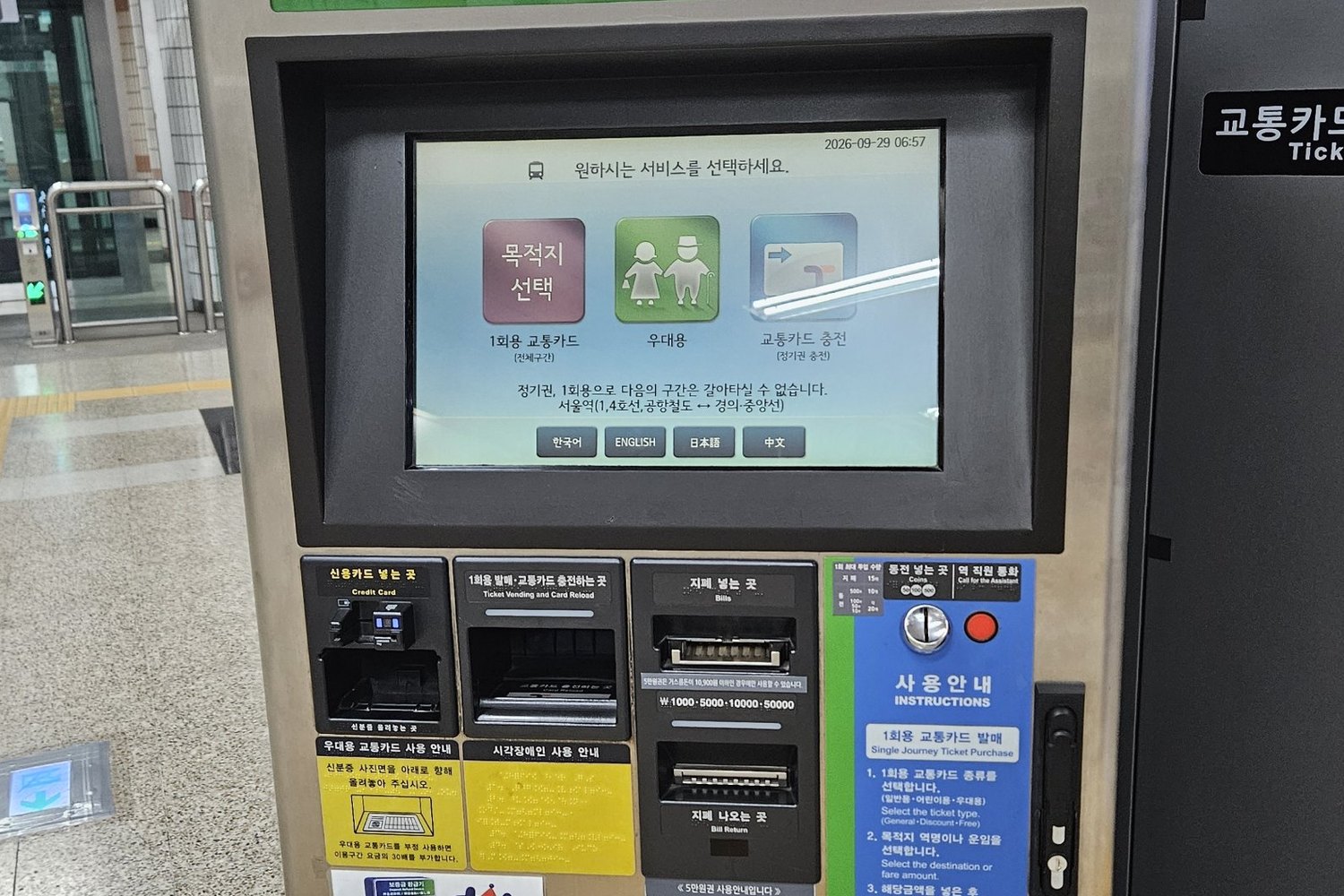
Cash, machines, cards, tap, pass. That's my list before every trip, and now you have the answers for the Seoul subway.
More on riding the Seoul subway and buses
Sources
- Seoul Metropolitan Government, public transport fares and transfer rules (updated Sept 18, 2025): news.seoul.go.kr
- Asia Economy on the June 28, 2025 fare rise (single ticket, teen and child fares): asiae.co.kr
- Seoul Metropolitan Government, foreign cards at the new ticket machines (Mar 2026): news.seoul.go.kr and which products take card payment: news.seoul.go.kr
- Seoul Metropolitan Government, night buses (updated Mar 20, 2026): news.seoul.go.kr
- Seoul Metropolitan Government, Climate Card tourist passes (updated Sept 28, 2026): news.seoul.go.kr
- Seoul Metropolitan Government, Climate Card end-of-service FAQ: news.seoul.go.kr
- The Korea Herald on the 5 am first-train plan (May 2025): koreaherald.com
- Munhwa Ilbo on the called-off strike, first train at 5:30 am (Dec 12, 2025): munhwa.com
- Seoul Shinmun on late-night service to 1 am on weekdays (June 2022): go.seoul.co.kr
- Money Today on priority and pregnancy seats (July 13, 2026): mt.co.kr
- Line 9 stations and express stops: Wikipedia
- Line colours: Wikipedia
- My own photos of the kiosks, gate and machines, Sept 28 and 29, 2026
— SeoulAslan


Comments
Post a Comment