

 SetPaying for Seoul transport
 Hi, I’m SeoulAslan
How Seoul Transit Fares and Transfers Work (2026)
Checked Sept 29, 2026
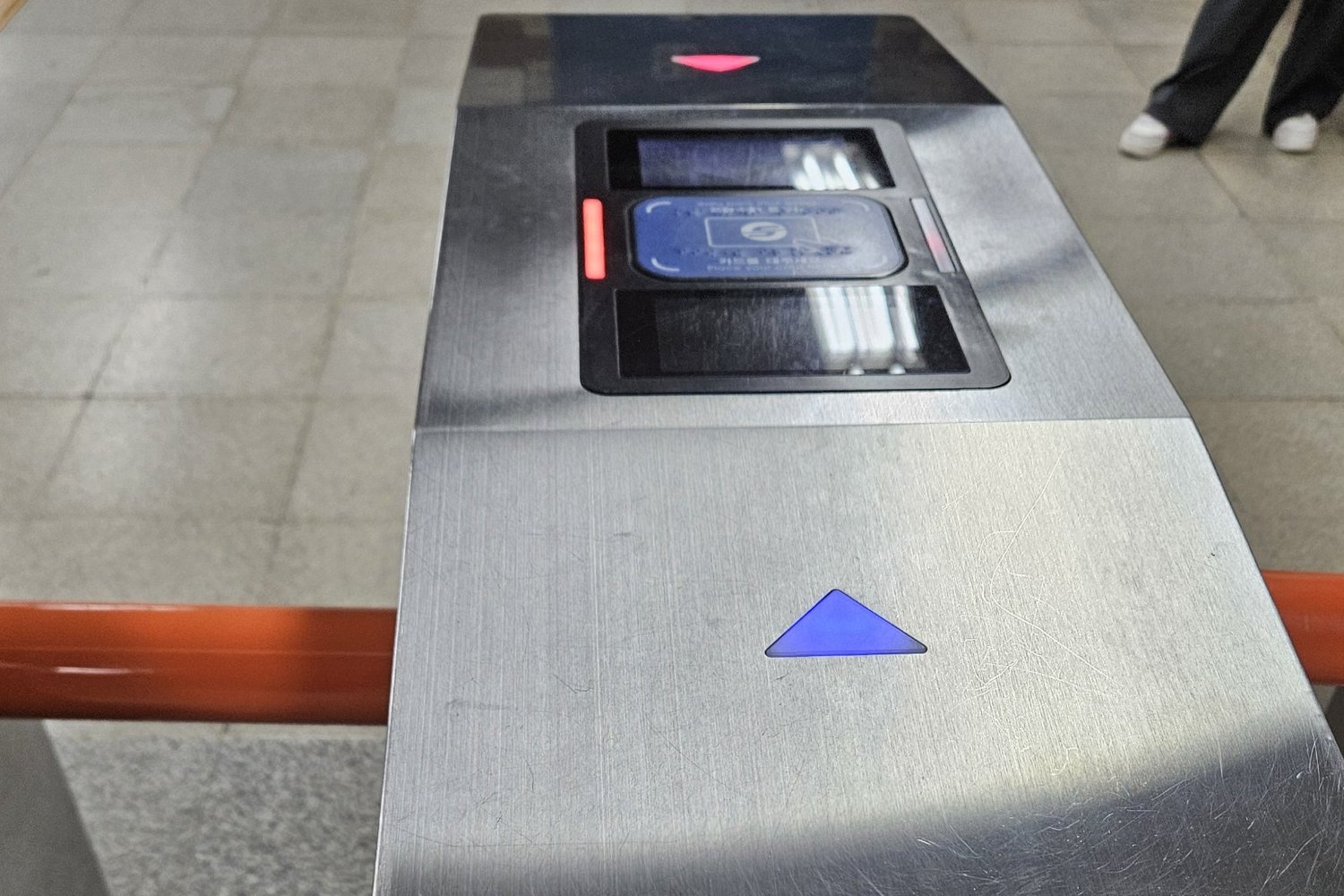
With a transit card, an adult pays 1,550 won on the Seoul subway and 1,500 won on a blue or green bus, for the first 10 km. Longer trips add 100 won per 5 km. Switch between bus and subway within 30 minutes (60 minutes from 21:00 to 07:00) and you pay one combined fare for the whole trip, up to 4 transfers, as long as you tap off every time. Cash and single tickets get no transfers. No fare rise has been announced as of Sept 29, 2026.
Before every trip I want to know how the ticket machines work and whether my card works. Behind both is the same question: what does a ride actually cost?
Jump to: Subway fares · Longer trips · How transfers work · Changing subway lines · What breaks a transfer · Leaving and coming back in · Late night and early morning · Are fares going up? · FAQ
How much is the Seoul subway fare in 2026?
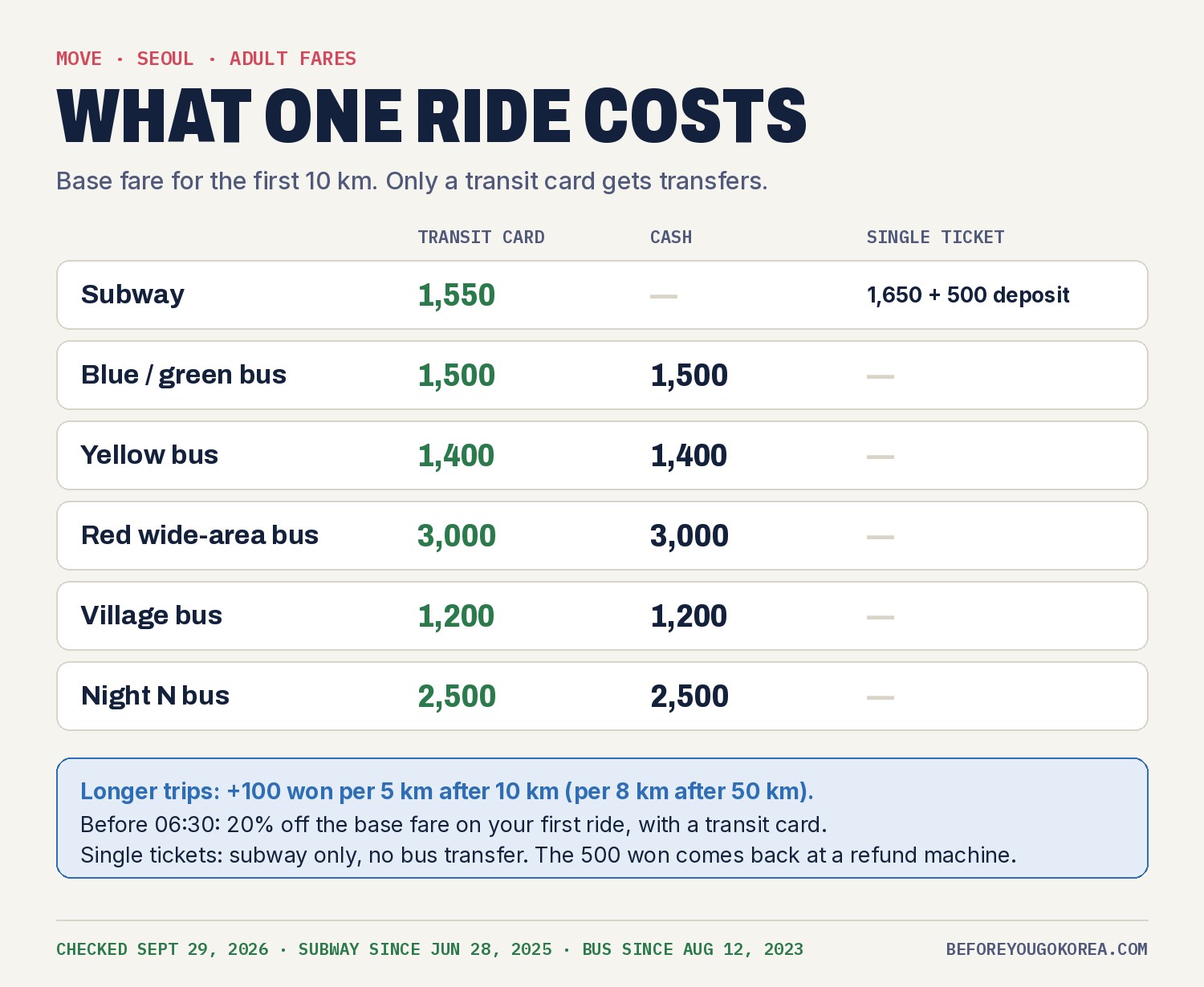
| Subway, first 10 km | Adult | Youth | Child |
|---|---|---|---|
| Transit card (T-money etc.) | 1,550 won | 900 won | 550 won |
| Single-journey ticket (1회용) | 1,650 won + 500 deposit | No youth price | 550 won |
These fares started on June 28, 2025, when the subway went up by 150 won across the capital area. Guides that still say 1,250 or 1,400 won are older than that.
You can't pay cash at the gate. Cash buys a single-journey ticket at a machine, or tops up a T-money card. A single ticket costs 100 won more, carries a 500 won deposit you get back at a deposit refund machine (보증금 환급기), and works on the subway only. It gets no bus transfer.
Buses are simpler: the adult fare is the same by card or by cash, 1,500 won on blue and green buses. The difference is that cash never gets a transfer. Bus types and colours are in the bus guide in this series.
How much more do longer trips cost?
Seoul charges by the total distance of your trip, not by the number of rides.
- Up to 10 km: the base fare only.
- 10 to 50 km: +100 won for every 5 km (80 won youth, 50 won child).
- Over 50 km: +100 won for every 8 km.
- Red wide-area buses: the base fare covers the first 30 km.
So a 15 km trip costs 1,650 won by card, and a 30 km trip 1,950 won.
Some private lines add a fare of their own. The Shinbundang Line (Gangnam to Pangyo and Gwanggyo) charges a separate 700 to 2,200 won per adult trip on top, depending on the sections you ride.
How do free transfers work in Seoul?
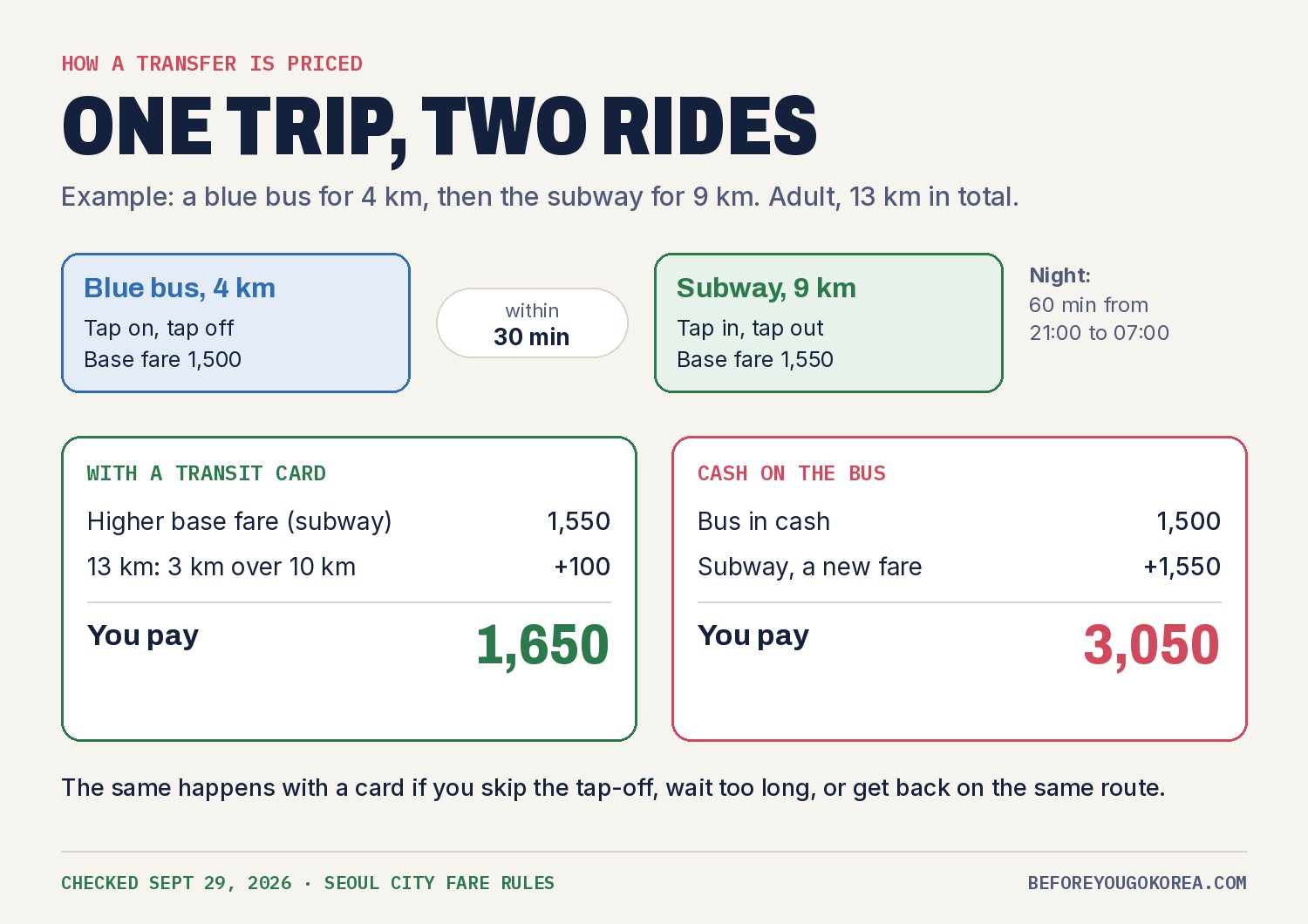
"Free transfer" is almost right. A transfer isn't a second fare. The system joins your rides into one trip and charges it by total distance. The rules, from the city's transfer page:
- Use a transit card. T-money (plastic or on your phone) or a Climate Card. One card per person.
- Tap on and tap off every ride, bus included.
- Board the next ride within 30 minutes of tapping off. From 21:00 to 07:00 you get 60 minutes.
- Up to 4 transfers, so 5 rides in one trip.
- You pay the highest base fare of the rides you took. Bus (1,500) then subway (1,550)? The trip starts at 1,550. Onto a red bus? The trip goes up to 3,000.
- Distance is added for the whole trip, as above.
It works across Seoul, Incheon and Gyeonggi buses and the capital-area subway, including AREX, GTX-A and the Han River Bus. Gyeonggi buses have higher fares (1,650 won for a regular city bus by card since October 25, 2025), so switching onto one can cost a little more.
On a Climate Card tourist pass, transfers don't matter inside Seoul. Every ride is already covered, but you still have to tap off.
Do I tap when changing subway lines?
Usually not. When you change lines inside the gates, you just walk to the other platform. The system reads where you came in and where you go out.
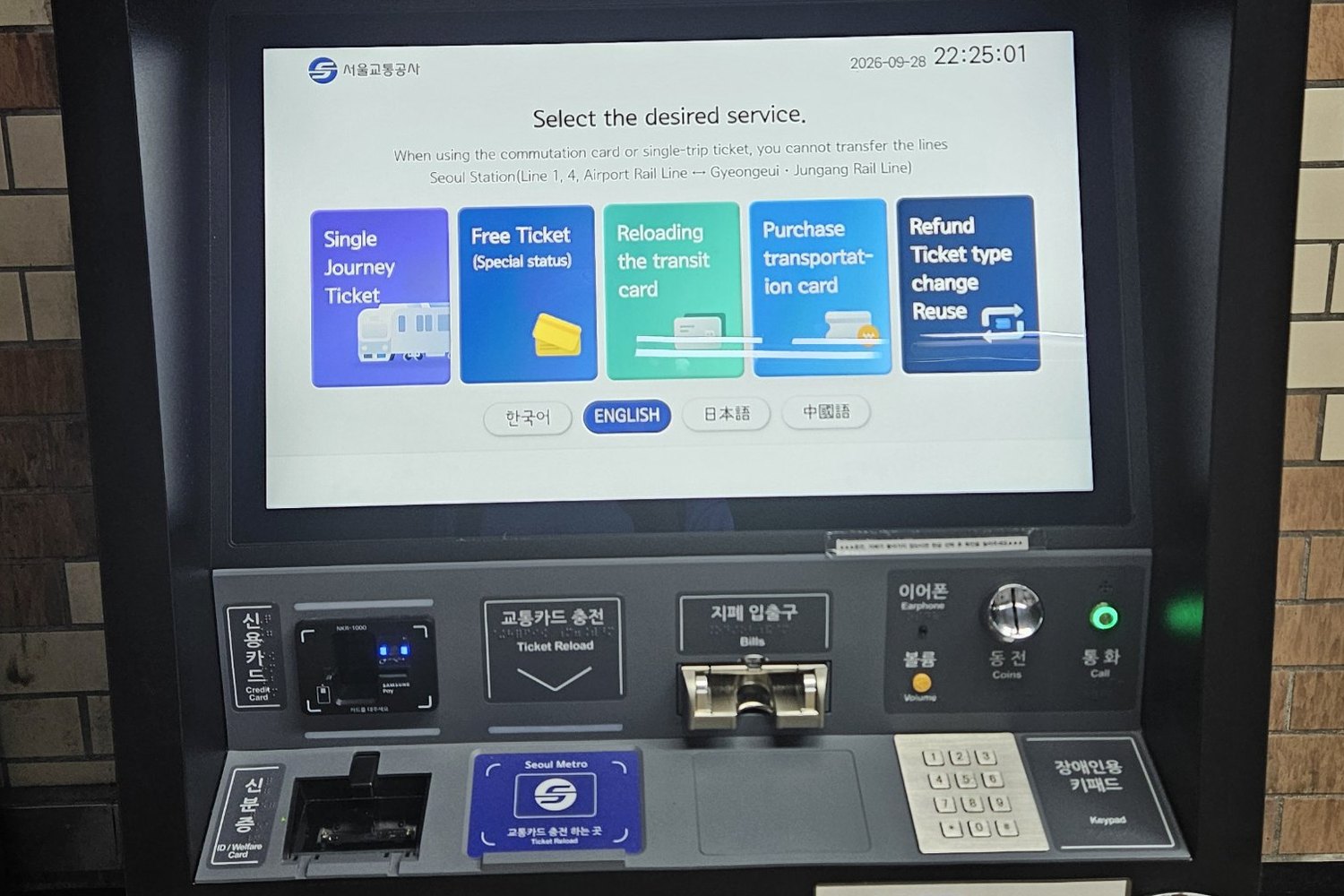
There are a few exceptions where lines run by different companies meet. The new ticket machines at Seoul Metro stations show one on their start screen: with a single ticket or a commuter pass, you can't transfer at Seoul Station between Lines 1 and 4 or AREX and the Gyeongui-Jungang Line. With T-money the transfer counts.
I photographed the gates and ticket machines at two Seoul subway stations on Sept 28 and 29, 2026. That notice was on the English screen:
What breaks a transfer?
- Not tapping off the bus. The city warns that the transfer chain breaks and you pay extra. On a Climate Card, two missed tap-outs block the card for 24 hours.
- Leaving the subway without tapping out. Since March 7, 2026, the capital-area subway adds a base fare (1,550 won adult) to your next ride if you walked out without tapping. Single tickets and commuter passes are exempt.
- Waiting too long. More than 30 minutes, or 60 minutes at night.
- The same route. Getting off and back on the same bus route, or the same vehicle, isn't a transfer.
- A fifth transfer. The sixth ride starts a new trip.
- Cash or a single ticket. Neither carries a transfer.
- Two cards in one wallet. If the reader charges the wrong card, your trip is split across two cards.
Travelling as a group? The city says several people paying on one card on a bus can still get transfers, as long as the same group stays together for the whole trip. One card each is simpler.
Can I leave the subway and come back in without paying again?
Yes, within 15 minutes, at the same station on the same line. It's meant for a wrong exit, a toilet or a forgotten bag.
- It has applied on Seoul Metro Lines 1 to 8, Line 9, the Ui-Sinseol Line and the Sillim Line since October 7, 2023.
- On the Korail-run sections of Lines 1, 3 and 4 and on Korail lines such as Suin-Bundang and Gyeongui-Jungang, it started on June 20, 2026.
- It does not apply on AREX, the Shinbundang Line or other private lines.
- Transit cards only, once per trip.
Some older guides say 10 minutes. That was the rule before October 2023.
Is there a late-night fare in Seoul?
Not on the subway or the regular buses. The fare is the same at 23:00 as at noon. What changes at night:
- The transfer window doubles to 60 minutes from 21:00 to 07:00.
- Owl buses (올빼미버스, route numbers starting with N) run from 23:00 to 06:00 and cost 2,500 won.
- Taxis do have a late-night surcharge. See Uber and Kakao T in Korea.
Early risers get a discount instead: the first ride before 06:30 is 20% off the base fare with a transit card. For an adult on the subway that is 1,240 won.
Are Seoul transit fares going up?
Nothing is announced for the subway or city buses as of September 29, 2026. The last subway rise was June 28, 2025. City bus fares haven't changed since August 12, 2023.
Two things are moving, though:
- Village buses (마을버스): operators are asking the city to raise the fare from 1,200 to at least 1,700 won. The city says it hasn't decided.
- Gyeonggi buses already went up on October 25, 2025.
I'll update this page with the date if anything changes.
Korean words for transfers and tickets
| English | Korean | Where you'll see it |
|---|---|---|
| Transfer | 환승 | Reader screen and voice when a transfer counts |
| Transit card | 교통카드 | Machines and signs |
| Single-journey ticket | 1회용 교통카드 · 1회권 | Machine menu |
| Deposit refund machine | 보증금 환급기 | Near the gates |
| Base fare / extra fare | 기본운임 / 추가운임 | Fare tables |
| Early-bird discount | 조조할인 | Before 06:30 |
FAQ
How long is the transfer time in Seoul?
30 minutes from when you tap off, or 60 minutes between 21:00 and 07:00. Up to 4 transfers.
Is the bus-to-subway transfer free?
Nearly. You pay one fare for the whole trip: the higher base fare plus any distance extra. Bus then subway inside 10 km costs 1,550 won in total.
Do I get a transfer if I pay cash?
No. Transfers only work with a transit card.
What happens if I forget to tap out?
On a bus you lose the transfer. On the subway, since March 7, 2026, a base fare is added to your next ride. On a Climate Card, two misses block it for 24 hours.
Base subway fares are in our subway basics guide.
Things I could not confirm:
- Exactly how a transfer onto an Owl night bus is priced. A Korean guide says you pay the difference up to 2,500 won, but the city's transfer page doesn't list night buses separately.
- Whether the youth and child fares need a registered card for visitors, and how a foreign teenager registers one.
- Whether any fare change will be announced for 2027. Nothing is scheduled as of Sept 29, 2026.
When my family went to Europe in September 2024, the one travel card I got in Korea was so useful, with no hassle at all. Seoul can feel the same, as long as your one card is a transit card and you tap it off every time.
More on riding the Seoul subway and buses
Sources
- Seoul Metropolitan Government, subway fares: sftc.seoul.go.kr · bus fares: sftc.seoul.go.kr
- Seoul Metropolitan Government, transit fares and "higher base fare" rule (updated Sept 18, 2025): news.seoul.go.kr
- Seoul Metropolitan Government, fare guide with distance and early-bird rules (updated July 11, 2025): news.seoul.go.kr
- Seoul Metropolitan Government, integrated transfer discount: news.seoul.go.kr
- Seoul Metropolitan Government, single-journey tickets: news.seoul.go.kr
- Seoul Metropolitan Government, 15-minute re-entry from Oct 7, 2023: news.seoul.go.kr
- Financial News on the Korail 15-minute re-entry from June 20, 2026: fnnews.com
- Newspim on the subway tap-out rule from March 7, 2026: newspim.com
- Seoul Metropolitan Government, Climate Card tap-out rule: news.seoul.go.kr
- Seoul Metropolitan Government, Owl night buses: news.seoul.go.kr
- Shinbundang Line, fares (as of June 28, 2025): shinbundang.co.kr
- Kyunghyang Shinmun on Gyeonggi bus fares from Oct 25, 2025: khan.co.kr
- Newspim on the village bus fare request (Sept 2026): newspim.com
— SeoulAslan


Comments
Post a Comment