
Can You Use Uber in Korea? Why Everyone Uses Kakao T (2026)
Checked Sept 27, 2026
Yes, you can use Uber in Korea, but only to call ordinary licensed taxis. Private-car UberX was shut down in 2015 and there is no Grab. Koreans use Kakao T: in February 2026 it had about 13.6 million monthly users against about 650,000 for Uber Taxi, roughly 95% of the market. As a visitor, bring Uber (your home card works), add k.ride (Kakao's app for foreigners) or Kakao T set to pay the driver, and remember you can still hail a taxi on the street.
Everyone in Korea uses Kakao T. Even when I send my elderly parents off in a taxi, I call it on Kakao T. It works exactly the way Uber or Grab does. This guide is the part a visitor needs: why Korea ended up this way, which app to install, what the taxis cost in 2026, and how to pay.
Jump to: Why no Grab or UberX · How big Kakao T is · Kakao T as a foreigner · k.ride · Uber today · Taxi types and fares · Paying · Street hail and addresses · Which one to use · FAQ
Why is there no Grab or UberX in Korea?
Korean law does not let a private car carry paying passengers. So the ride-sharing model you know from other countries, where anyone with a car can drive for an app, never survived here. What survived is a different thing: an app that calls a licensed taxi.
- March 2015: Uber suspended UberX in Seoul after talks with the city. Seoul had already offered cash rewards for reporting UberX drivers, and in 2017 a Seoul court fined Uber's Korean arm for running the service.
- December 2018: Kakao started testing a carpool service inside Kakao T. Taxi drivers rallied against it in huge numbers, and Kakao halted the test in January 2019. That March, a deal between the taxi industry, Kakao, the government and the ruling party limited carpooling to weekday rush hours.
- 2018 to 2020: Tada ran 11-seat vans with drivers through a rental-law loophole. Taxi drivers fought it just as hard.
- March 2020: the National Assembly passed what everyone calls the "Tada ban". Rented vans with drivers are now allowed only for tourism trips of 6 hours or more, or pick-ups and drop-offs at airports and ports. Tada's main service ended in April 2020. The Constitutional Court upheld the law in June 2021, and again in a separate case in March 2026.
The fight was bitter. Between December 2018 and May 2019, three taxi drivers died by self-immolation in protest, the first two against Kakao's carpool plan and the third against Tada.
Kakao T won by doing the opposite of replacing taxis. It put the existing licensed taxis into one app. My own view: Kakao T is simply the Korean version of the ride apps that already existed. Korea has powerful taxi unions, so it's a good app built to fit our situation. The unions clashed with Tada a lot too. That's settled now, but it went as far as drivers dying over it.
How big is Kakao T?
Very. In February 2026 Kakao T had about 13.58 million monthly active users. Uber Taxi, the number two, had 654,357, down from about 800,000 two months earlier (CEO Score Daily). Measured by monthly users, Kakao T holds about 95% of the taxi-app market.
Being that big has put Kakao Mobility in court more than once. A court cancelled a regulator's fine over claims that it steered rides to its own Blue taxis, and prosecutors dropped that case in January 2026. At the same time they charged the CEO and two other executives over claims that Kakao cut off ride requests to drivers working with rival apps from 2021 to 2023. That case is still going. None of this changes how you ride, but it explains why Koreans complain about Kakao T and still open it every day.
Uber's own path here was bumpy. In 2021 it teamed up with SK's navigation company Tmap to form UT (Uber 51%, Tmap 49%). In February 2024 UT was renamed Uber Taxi, so a visitor's normal Uber app works in Korea. In December 2024 Tmap sold its stake to Uber and left taxi-hailing.
Can a foreigner use Kakao T?
Yes, with two catches: sign-up and paying in the app.
- Sign-up: Kakao T uses a Kakao account. Travellers report signing up with a foreign number (+1, +44, +81 and so on). One 2026 guide says approval for a foreign number can take a few days, so do it at home, not at the airport.
- Language: the app runs in English. Switch it in the settings.
- Paying in the app: Kakao Mobility says Visa, Mastercard, Amex and JCB cards issued abroad can be registered. In practice many travellers still get "invalid card" or verification errors in 2026, because the payment step is tied to Korea's card-verification system.
- The fix: in the payment list, choose the option to pay the driver directly (직접결제). You call the taxi without a card on file, then pay in the taxi with your card, T-money or cash.
Why nobody accepts your call: on a normal Kakao T call the driver sees your destination before accepting, so short trips get skipped. Kakao T Blue taxis are auto-dispatched instead, and the driver can't pick. You pay a call fee on top of the meter for that. The app shows the fee before you confirm.
When I lived in Vietnam, for about five years, Grab came first, so I really used it every single time. Before Kakao T came out in Korea, I had already used Uber a lot abroad. If you've done the same, Kakao T will feel familiar: set the pickup pin, type the destination, watch the car come to you.
What is k.ride?
k.ride is Kakao Mobility's own app for visitors, launched in June 2024. It calls the same Kakao taxi network, but it's built for people without Korean anything.
- Sign-up: Google, Apple or email. No KakaoTalk account needed.
- Pay: foreign credit or debit cards and Alipay+, charged in the app.
- Language: English, Chinese and Japanese. Destination search and driver chat are auto-translated from 133 languages.
- Where you can download it: the app stores of 34 countries, so check yours before you fly.
- Cars: Standard (a Kakao T Blue taxi), Deluxe, Comfort (a van, Kakao T Venti) and Luxury (Kakao T Black).
- Help: in-app support, Monday to Friday, 9 am to 2 am Korean time.
The fee. k.ride's terms for Korea add a 10% service fee to every car type. Cancel more than a minute after a car is assigned and you may pay a cancellation fee (2,000 won for Deluxe, 4,000 for Comfort, 5,000 for Luxury). You're paying for convenience: no card problems, no Korean. For a 12,000 won ride that's about 1,200 won. Compare the estimate with Kakao T or Uber if you have both.
It's growing fast. Kakao says k.ride sign-ups in the first half of 2026 were up 65% on a year earlier and ride calls up about 120%.
Does Uber work in Korea?
Yes. Open the same Uber app you use at home. The big advantage: the card already on your account works, and you don't need to set anything up. Uber says visitors from 138 countries rode Uber Taxi in Korea in 2025.
What you'll see in Seoul (Uber's Seoul taxi page):
- Standard Taxi: a regular taxi on the meter
- Uber Taxi: Uber's own branded taxis
- Speed Call: faster dispatch for a 3,000 won fee
- Green: an electric taxi for a 1,000 won fee
- Deluxe Taxi: the black 모범 (mobeom) deluxe taxi
- XL for luggage, and Uber Black, a fixed-price premium car launched for Seoul and Incheon Airport in July 2024
You can also choose to pay in person and settle in the taxi. The catch is supply. With roughly one user for every twenty on Kakao T, Uber can show "no cars available" late at night or outside big cities. That's the moment to switch apps or walk to a main road.
What taxi types are there, and what do they cost?
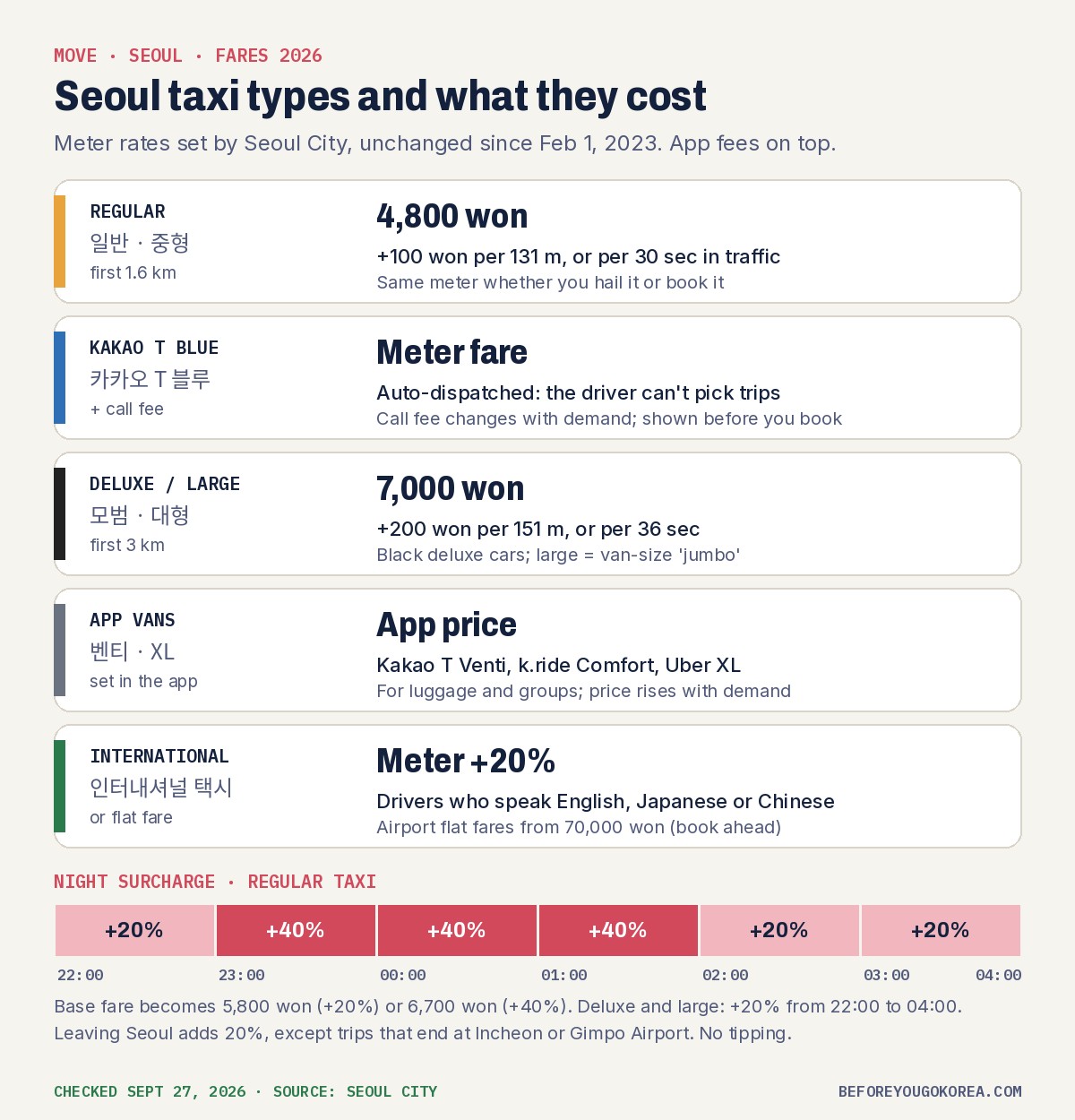
Seoul's meter fares haven't changed since Feb 1, 2023 (Seoul City taxi fares, page updated April 2026). There has been talk in the Korean press of a rise to around 5,500 won, but no decision as of this check.
| Type | Korean | Day fare | Night | Good for |
|---|---|---|---|---|
| Regular (midsize) | 일반 · 중형택시 | 4,800 won for 1.6 km, then 100 won per 131 m or per 30 sec in slow traffic | +20% 22–23h and 02–04h, +40% 23–02h | Almost every trip |
| Kakao T Blue | 카카오 T 블루 | Meter fare + call fee | Same meter surcharge | When nobody accepts a normal call |
| Deluxe | 모범택시 | 7,000 won for 3 km, then 200 won per 151 m or per 36 sec | +20% 22–04h | More room, experienced drivers |
| Large ("jumbo") | 대형승용택시 | Same as deluxe | +20% 22–04h | Groups and luggage |
| App vans | 벤티 · XL | Price set in the app, rises with demand | In the app price | Airport runs with big suitcases |
| International Taxi | 인터내셔널 택시 | Meter +20%, or flat airport fares from 70,000 won | Surcharges apply | A driver who speaks English, Japanese or Chinese |
Using the city's rates, a 10 km daytime ride in light traffic is about 11,000 won on a regular meter. Sitting in traffic adds 100 won every 30 seconds. At 1 am the same ride costs about 40% more.
Leaving Seoul adds a 20% out-of-city surcharge, but not on trips that end at Incheon or Gimpo Airport. Highway tolls are extra and you pay them. The International Taxi is booked on intltaxi.co.kr or 1644-2255; online bookings close 24 hours ahead.
How do you pay for a taxi in Seoul?
- Foreign card in the taxi: the T-money Mobility taxi terminal lists Visa, Mastercard, UnionPay, JCB and American Express, plus Alipay, WeChat Pay and UnionPay QR codes (T-money Mobility).
- T-money: the same transit card you use on the subway works in taxis. Since April 2026, iPhone users can load T-money in Apple Wallet with a foreign Mastercard through the MobileTmoney app, and Android users can use the KOREA TOUR CARD app (Mastercard, April 9, 2026).
- Cash: Korean won is always accepted.
- In the app: Uber with your home card, k.ride with a foreign card or Alipay+.
- Tip: none. Don't add one, and if a driver asks, you can say no.
- Receipt: ask for one (영수증 주세요, yeongsujeung juseyo). It has the taxi's number if you need to report a problem or find a lost bag.
Can you just hail a taxi on the street?
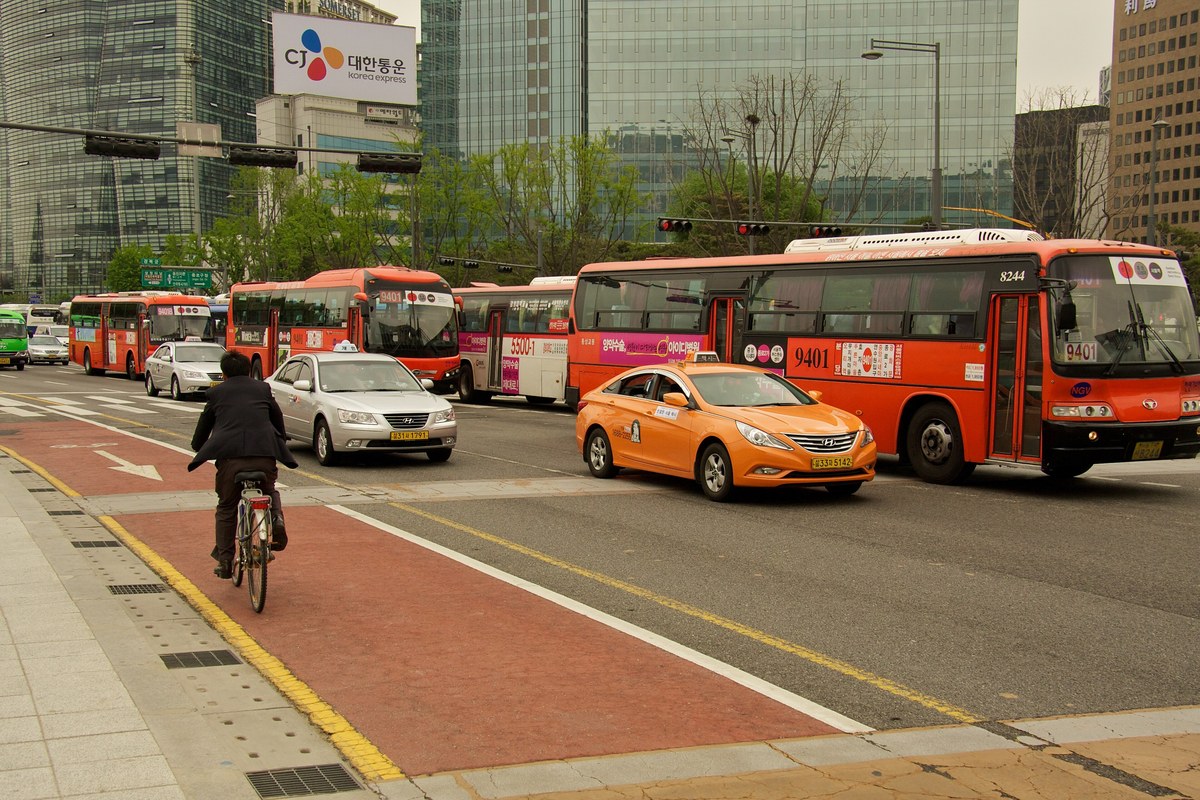
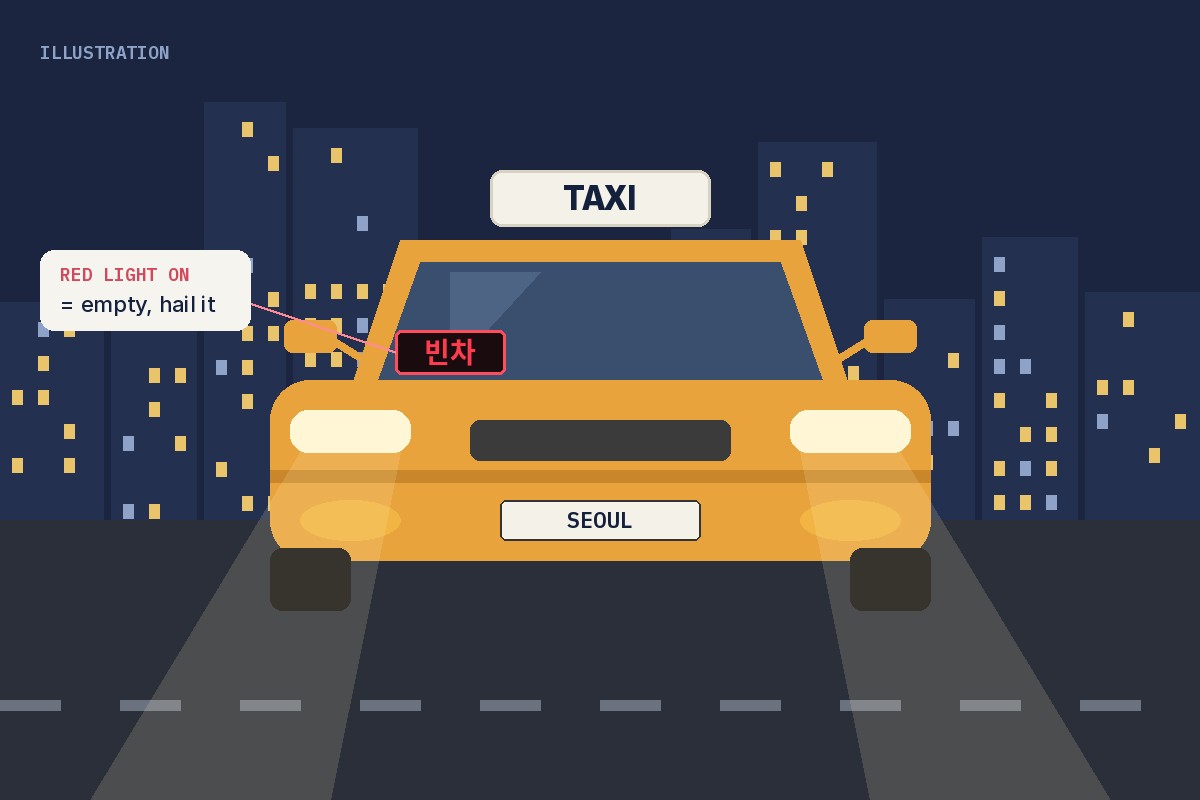
Yes, and it's often the fastest option in central Seoul. Look for the red light on the passenger side of the windscreen reading 빈차 (bincha, "empty"). Stand where the taxi can pull in safely and wave. Taxi stands outside stations, big hotels and department stores also work.
The hard hours are late at night, from about 11 pm to 2 am, in nightlife areas. That's also when the meter is at +40%. Book a Blue or an Uber Speed Call early, or walk a block to a main road.
Show the driver a Korean address. Many drivers speak little English, and the destination in your head may not match what they know. Before you get in:
- Find the place on Naver Map or Kakao Map and copy the Korean name and address.
- Keep it on your screen, large, and show it when you get in.
- For a hotel, the Korean name matters more than the English one.
- In an app, set the pickup pin by hand. GPS often drifts in the middle of tall buildings.
| Korean | Say it | Means |
|---|---|---|
| 빈차 | bincha | Empty, available (the red light) |
| 여기로 가 주세요 | yeogiro ga juseyo | Please go here (while showing your screen) |
| 카드 돼요? | kadeu dwaeyo? | Can I pay by card? |
| 여기서 세워 주세요 | yeogiseo sewo juseyo | Please stop here |
| 영수증 주세요 | yeongsujeung juseyo | Receipt, please |
| 직접결제 | jikjeop gyeolje | Pay the driver directly (Kakao T setting) |
If something goes wrong, call 120 (Seoul's Dasan call centre) or 1330 (Korea Travel Hotline, English available) with the taxi number from your receipt.
So which one should you use?
| Kakao T | k.ride | Uber | Street hail | |
|---|---|---|---|---|
| Sign-up | Kakao account; foreign number reported to work | Google, Apple or email | Your home account | None |
| Pay | Foreign card often fails; pay the driver | Foreign card, Alipay+ in the app | Home card in the app, or pay in person | Card, T-money or cash in the taxi |
| Extra cost | None on a normal call; Blue has a call fee | 10% service fee in its terms | None on Standard Taxi; Speed Call 3,000 won | None |
| Taxis | The most, by far | Kakao's Blue and other Kakao cars | Fewer, busiest in big cities and airports | Whatever passes |
| Best for | Longer stays, anyone comfortable in the app | Short trips, no card problems | First day, airport runs | Central Seoul in the daytime |
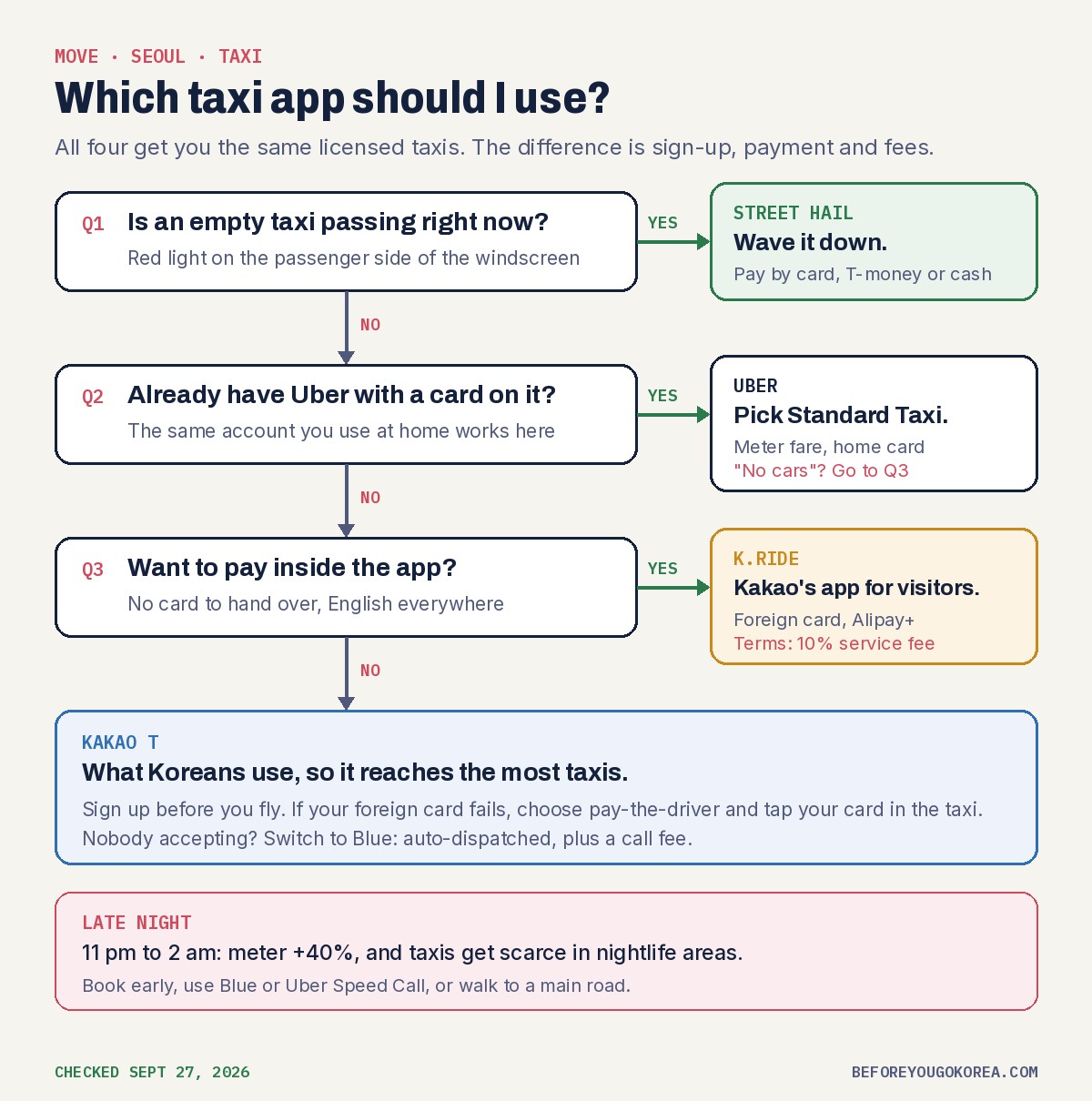
The short answer: install Uber and k.ride before you fly, and add Kakao T if you're staying more than a few days. Use the street when an empty taxi is right in front of you.
FAQ
Can I use Uber in Seoul?
Yes. The Uber app calls licensed taxis in Seoul, and your home card works. There is no UberX with private cars.
Does Kakao T work with foreign credit cards?
Sometimes. Kakao says Visa, Mastercard, Amex and JCB can be registered, but many travellers get errors. Choose pay-the-driver and pay by card in the taxi.
Do I need a Korean phone number for Kakao T?
Travellers report signing up with a foreign number, though it can take time. If it doesn't work, k.ride signs you up with Google, Apple or email.
Is k.ride more expensive than Kakao T?
Its terms add a 10% service fee on top of the fare. Check the estimate in both apps if you have both.
Do you tip taxi drivers in Korea?
No. The meter price is the price.
Things I could not confirm yet:
- Kakao T Blue's current call fee. The last public figures I found are from 2022–23 news reports (up to 3,000 won, with late-night fees up to 5,000 won). The app shows the fee before you call.
- Whether Kakao T takes foreign cards for regular and Blue taxis in 2026, and the exact English name of its pay-the-driver option. Travellers' reports are mixed.
- Whether k.ride's 10% service fee shows up on every ride. It's in the terms, but a k.ride marketing blog says there are no hidden fees.
- That a normal Kakao T call is still free. The last official terms I could read (2021) say so, and the app shows any fee before you call.
- Whether Uber Black still runs in Seoul. It launched in July 2024 but isn't listed on Uber's current Seoul taxi page.
- Tapping a foreign card or Apple Pay on the taxi terminal. The terminal maker lists the card brands but doesn't mention contactless; travellers say it usually works.
- A Seoul fare rise. It has been discussed in the Korean press, with no decision as of Sept 27, 2026.
- The deluxe distance rate. Seoul's main fare page says 200 won per 151 m; another city page says 100 won.
In the end, Kakao T is just an app that found a smart way through how things really are in Korea. That's why everyone here uses it, me included. You don't have to. Uber and the red light on the street will get you home too.
Sources
- Seoul Metropolitan Government, Seoul taxi fares (fares from Feb 1, 2023; page updated April 3, 2026), and out-of-city surcharge exceptions for Incheon and Gimpo airports
- Uber Korea newsroom: UberX suspension notice (March 2015), Uber Black launch (July 2024), 2025 infographic (Dec 10, 2025); Uber Seoul taxi page
- Kakao Mobility: k.ride site and k.ride terms for Korea; Kakao Mobility report on foreign users (Dec 2023)
- CEO Score Daily, April 1 and May 6, 2026: Kakao T and Uber Taxi monthly users, market share
- Money Today, Jan 28, 2026: prosecutors' decisions on Kakao Mobility; Hankook Ilbo, Dec 20, 2024: Tmap leaves UT
- Edaily, Jan 15, 2019 (carpool test halted); Seoul Shinmun, March 7, 2019 (rush-hour carpool deal); Law Times, March 2020 (Tada ban); Etoday, June 24, 2021 (Constitutional Court); Hankook Ilbo, May 15, 2019 (driver deaths)
- T-money Mobility, taxi payment terminal; Mastercard, April 9, 2026
- Korea Daily, July 8, 2026: k.ride growth in the first half of 2026; International Taxi official site
— Aslan


Comments
Post a Comment