

 SetPaying for Seoul transport
 Hi, I’m SeoulAslan
Seoul Subway Ticket Machines: How to Use Them (2026)
Checked Sept 29, 2026
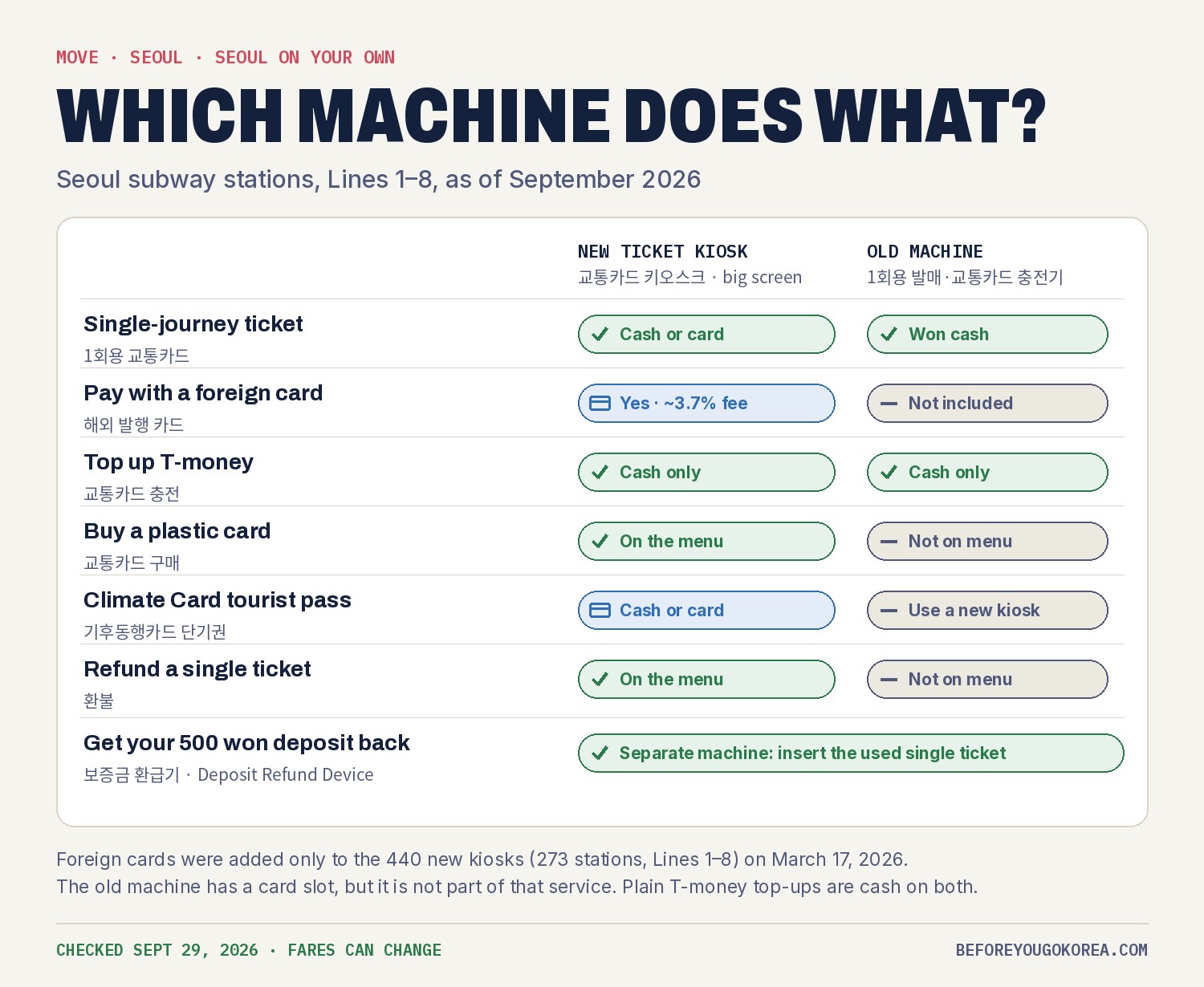
Seoul subway stations have two kinds of machine. The new ticket kiosk (big screen, Lines 1 to 8) sells single tickets and Climate Card passes and takes foreign cards, with a fee of about 3.7%. The old machine sells single tickets for won cash.
A single-journey ticket costs 1,650 won for an adult trip up to 10 km, plus a 500 won deposit. You get the deposit back at a separate Deposit Refund Device (보증금 환급기). Topping up a T-money card is cash only on both machines.
Before every trip abroad, one of the things I look up is how the ticket machines work. I photographed these machines at two Seoul subway stations on Sept 28 and 29, 2026. Here is what each one does, button by button.
Jump to: New or old? · Buy a single ticket · Seoul Station warning · Get the 500 won back · Foreign cards · Top up T-money · Buy a card · Call staff · FAQ
How do I tell the new kiosk from the old machine?
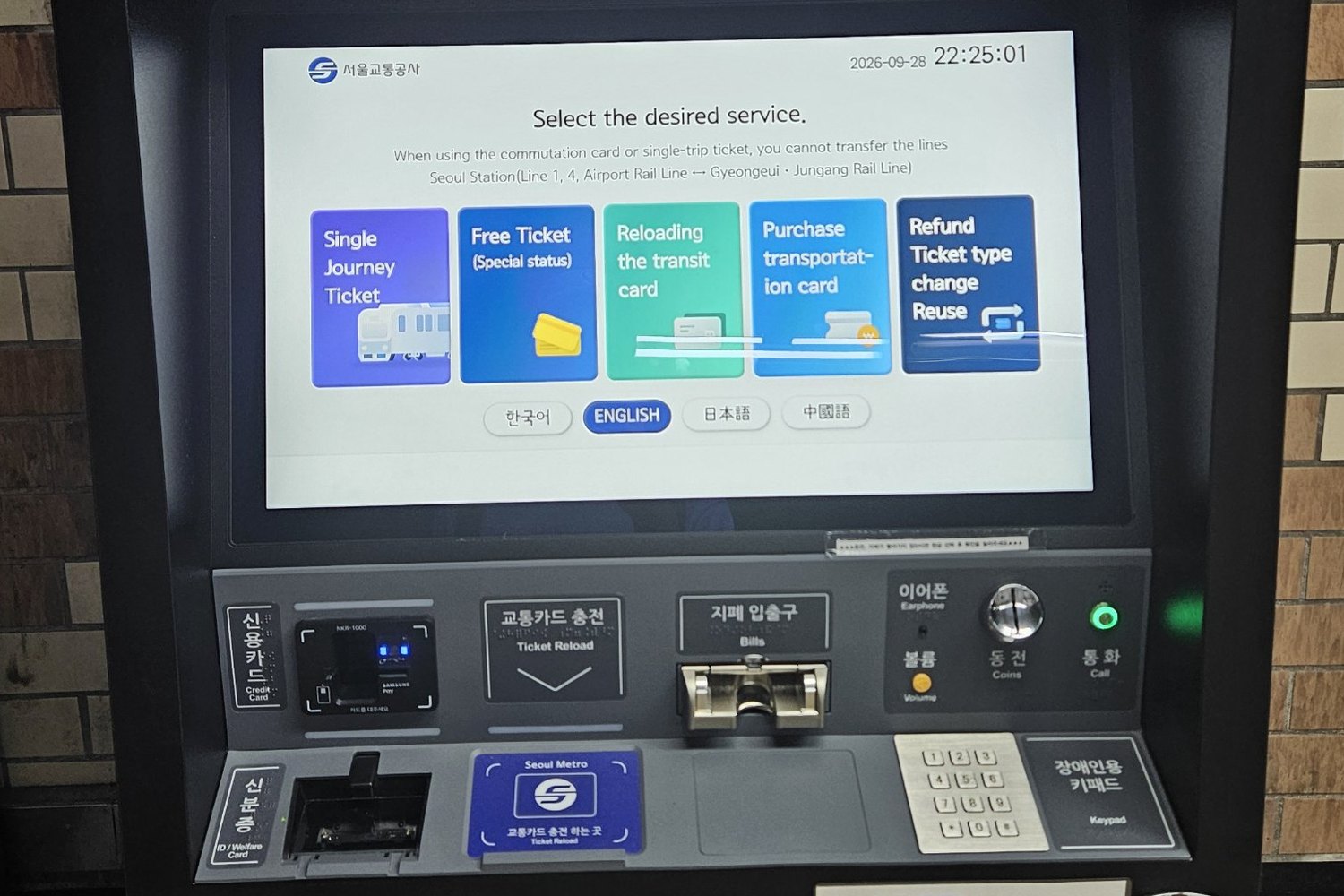
The new kiosk is dark grey with a wide touch screen and the Seoul Metro logo (서울교통공사) in the corner. Five coloured tiles fill the start screen. Under the screen you'll see a card reader marked 신용카드 Credit Card, a pad marked 교통카드 충전 Ticket Reload, a bill slot (지폐 입출구 Bills) and a coin slot (동전 Coins).
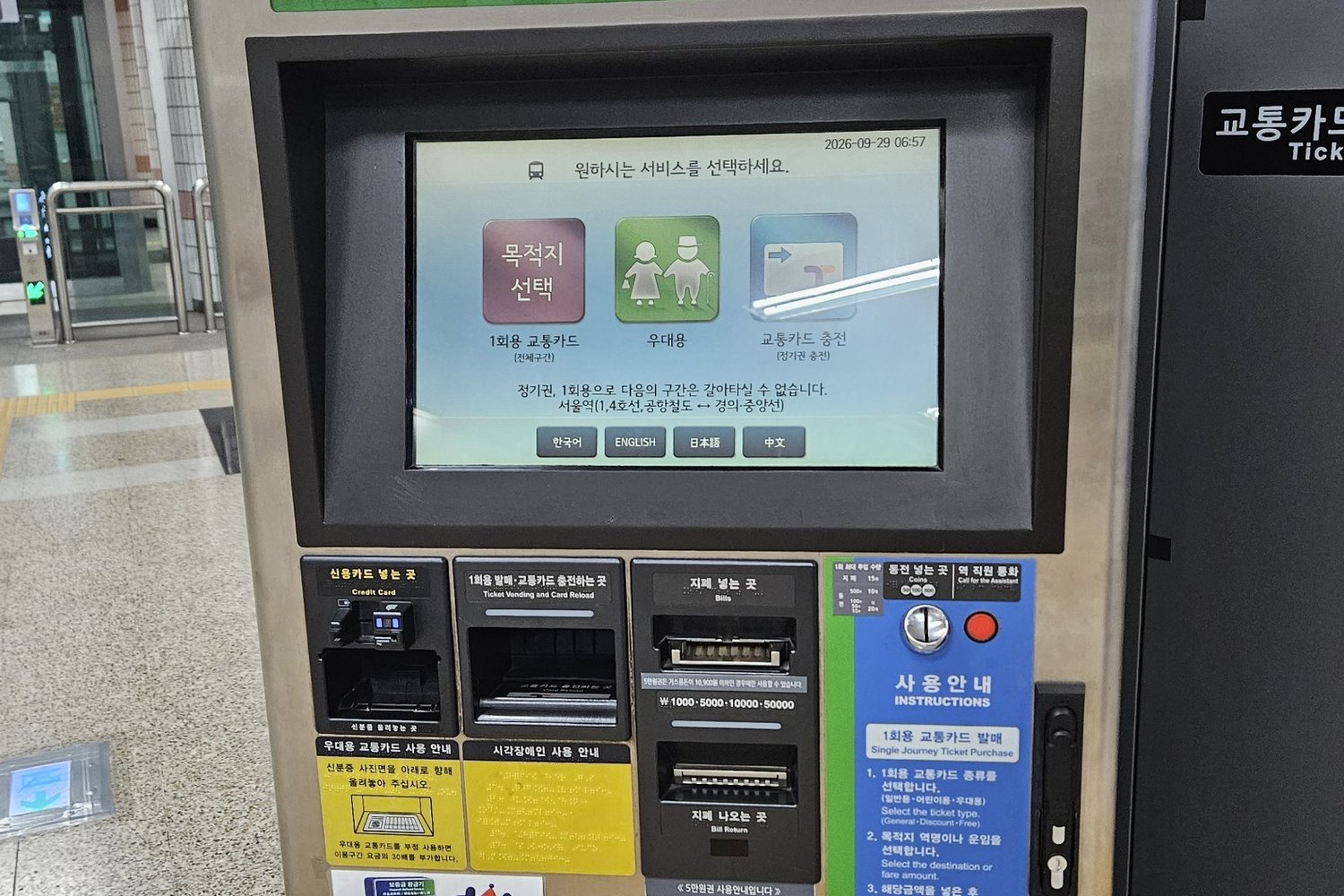
The old machine is stainless steel with a smaller screen. Its sign reads 1회용 발매·교통카드 충전기, "Ticket Vending and Card Reload Device". It offers three things: a single-journey ticket (1회용 교통카드), a free ticket for eligible Koreans (우대용), and a card reload (교통카드 충전). Both machines have an ENGLISH button on the first screen.
Foreign cards were added only to the new kiosks, on March 17, 2026. The city put 440 of them in 273 stations on Lines 1 to 8. The old machine has a credit card slot too, but it isn't part of that service, so treat it as a cash machine.
How do I buy a single-journey ticket?
A single-journey ticket (1회용 교통카드) is a plastic card good for one subway trip in the Seoul area. On the new kiosk:
- Tap ENGLISH, then Single Journey Ticket.
- Choose your destination station or the fare. The fare depends on distance.
- Pay by card on the card reader, or feed won notes and coins. The amount includes the 500 won deposit.
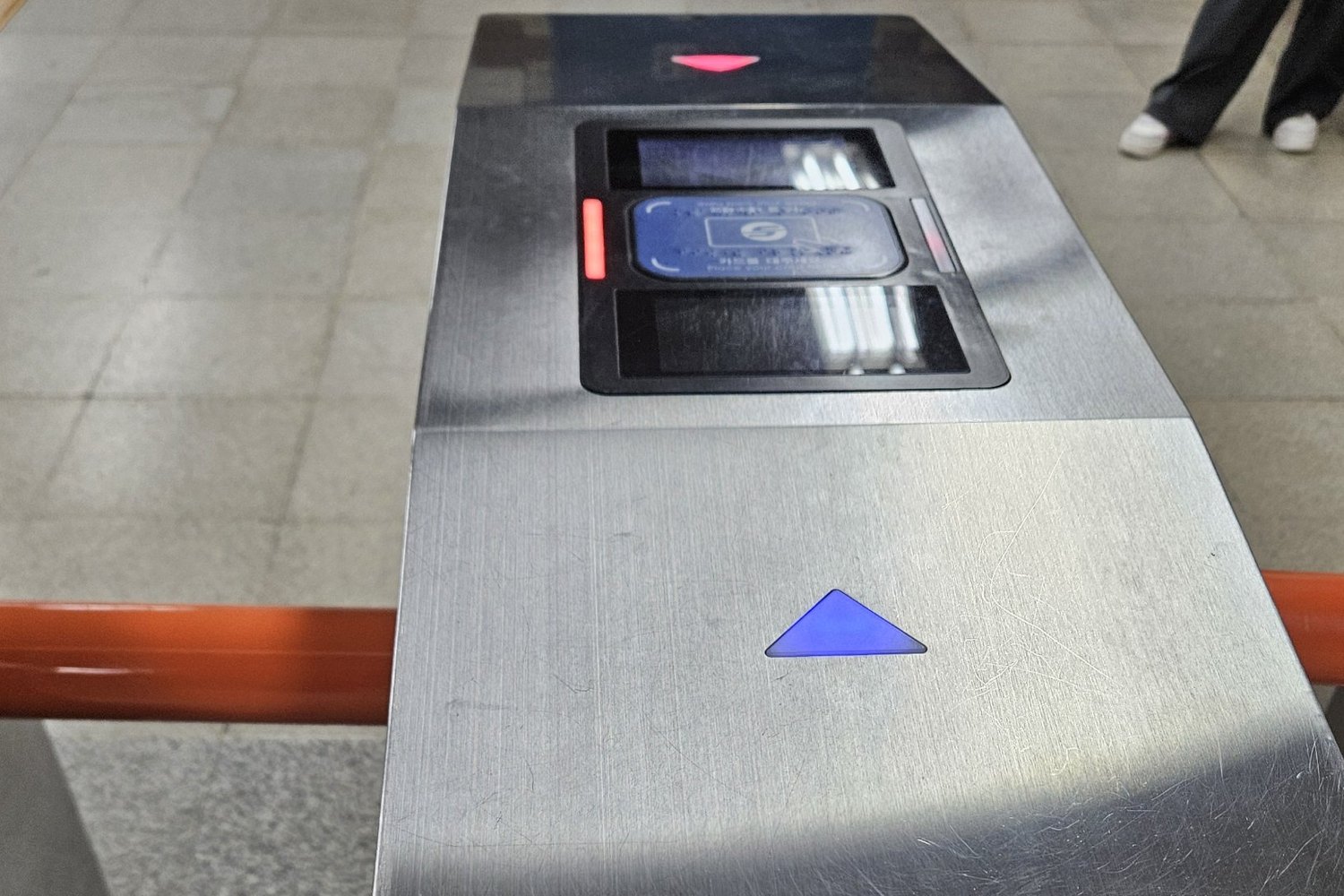
- Take the card from the tray. Tap it on the blue reader at the gate going in and again going out.
The old machine works the same way. Its instruction panel says: pick the ticket type, pick the destination or fare, then put in the money.
What it costs. A single ticket is 100 won more than the T-money fare. For an adult that is 1,650 won for up to 10 km, then 100 won more for each extra 5 km up to 50 km. With the deposit you put in 2,150 won for a short trip. Children pay the same as with a card (550 won base). Teenagers get no discount on a single ticket.
What it can't do. A single ticket gives no transfer discount to a bus; the city lists single tickets and cash as outside the transfer system. If you'll ride more than once or twice, a T-money card or a Climate Card pass is simpler.
Why does the screen warn about Seoul Station?
When I photographed the new kiosk, its English start screen carried a warning about Seoul Station. It reads: with a commuter card or single ticket, "you cannot transfer" at Seoul Station between Lines 1 and 4 or the Airport Rail Line and the Gyeongui–Jungang Line. The old machine shows the same line in Korean.
The reason is the layout. At Seoul Station the Gyeongui–Jungang platforms sit outside the gates of the other lines, so you walk out and tap in again. A single ticket's trip ends when you tap out, so it won't let you back in. On a T-money card, that walk counts as a transfer if you tap back in within the city's transfer window: 30 minutes, or 60 minutes between 21:00 and 07:00.
So if your trip changes lines at Seoul Station, buy a single ticket only to Seoul Station, or use T-money.
How do I get my 500 won deposit back?
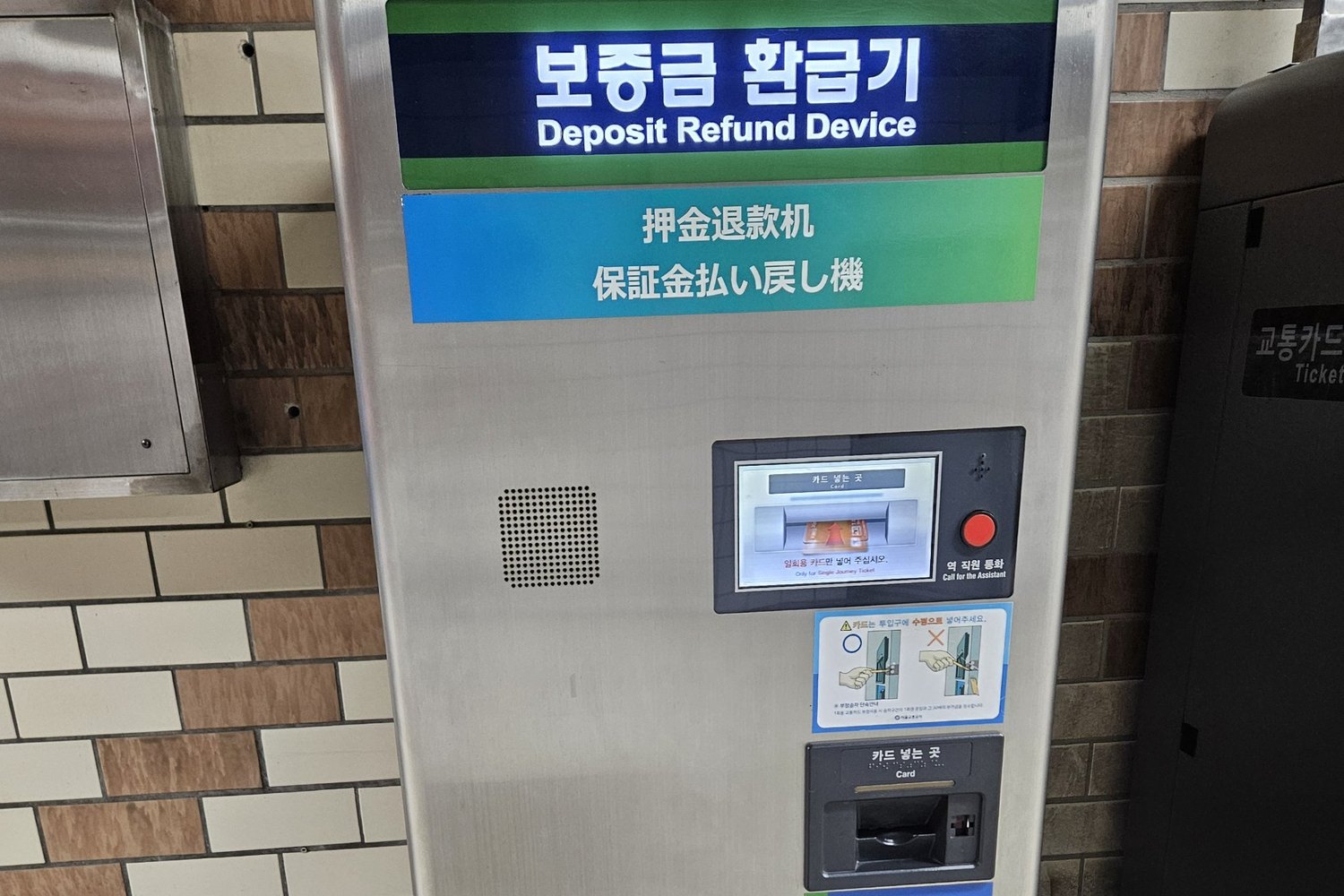
- After the gate, look for the 보증금 환급기 Deposit Refund Device. It is usually near the gates or the ticket machines.
- Push the used single ticket flat into the slot marked 카드 넣는 곳 Card. A sticker on the machine shows the card going in horizontally.
- Take your 500 won coin. The machine keeps the card, which gets reused.
The screen says it is "Only for Single Journey Ticket". Don't put a T-money card in it. The city says you can claim the deposit any time, as long as the card isn't lost or damaged.
Which machines take foreign cards, and for what?
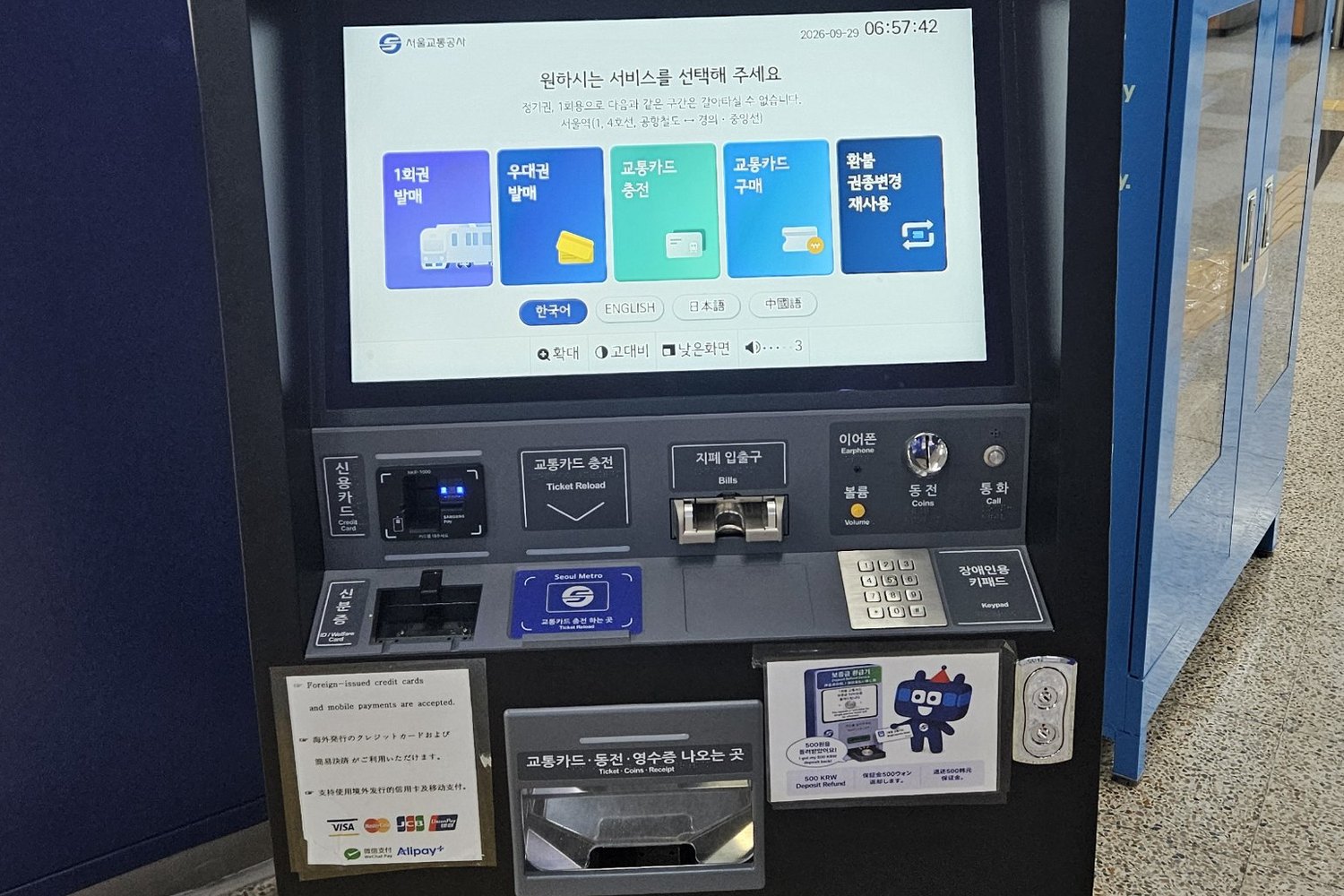
Only the new kiosks on Lines 1 to 8. The sticker I photographed on one lists Visa, Mastercard, JCB, UnionPay, WeChat Pay and Alipay+. Korean Kakao Pay and Naver Pay work too.
A foreign card buys two things here:
- Single-journey tickets.
- The Climate Card tourist pass (기후동행카드 단기권): 5,000 won for 1 day, 8,000 for 2, 10,000 for 3, 15,000 for 5 and 20,000 for 7. The card itself costs 3,000 won.
The city puts the foreign-card fee at about 3.7% on average. In the first month, the busiest stations for foreign cards were Seoul Station, Hongik University and Myeongdong.
What a foreign card can't do is top up an ordinary T-money card. The city's FAQ lists card payment for single tickets, commuter passes and the Climate Card short-term pass only. Prepaid cards are cash.
Can I top up T-money at the machine?
Yes, with won cash. On the new kiosk:
- Tap Reloading the transit card.
- Lay your card on the pad marked 교통카드 충전 Ticket Reload and leave it there.
- Choose an amount and feed in notes. Top-ups go in 1,000 won steps.
On the old machine, the option is 교통카드 충전, and the card goes in the tray marked Ticket Vending and Card Reload. The old machine I photographed takes 1,000, 5,000, 10,000 and 50,000 won notes and 50, 100 and 500 won coins. A label under its bill slot says a 50,000 won note only works when the change is 10,900 won or less. So a 50,000 won note won't buy a single ticket there. Carry some 1,000 and 10,000 won notes.
Can I buy a T-money card at the kiosk?
The new kiosk has a Purchase transportation card tile. The city says the kiosks sell plastic transit cards, including the Climate Card (3,000 won), which you then load with a tourist pass. The old machine doesn't sell cards.
Plain T-money cards are also sold at convenience stores (GS25, CU, 7-Eleven, emart24). Designs and prices vary. T-money's own card for visitors, the TMONEY TRAVEL CARD, is 4,000 won. The card price isn't refundable. Only the balance is.
What if something goes wrong?
- New kiosk: press the 통화 Call button to the right of the coin slot.
- Old machine and deposit machine: press the red 역 직원 통화 Call for the Assistant button.
- Phone: Seoul Metro's customer line is 1577-1234.
Skip the Free Ticket (Special status) tile. It is the 우대용 ticket for eligible seniors and people with disabilities. You put Korean ID on the scanner, and a label on the old machine warns that misuse costs 30 times the fare.
Signs to match
| Korean | English on the machine | What it's for |
|---|---|---|
| 1회권 발매 / 1회용 교통카드 | Single Journey Ticket | One subway trip, 500 won deposit |
| 교통카드 충전 | Reloading the transit card / Ticket Reload | Top up T-money with cash |
| 교통카드 구매 | Purchase transportation card | Buy a plastic card |
| 환불·권종변경·재사용 | Refund, Ticket type change, Reuse | Refund a single ticket or pass |
| 우대권 발매 / 우대용 | Free Ticket (Special status) | Korean seniors and disabled only |
| 지폐 입출구 / 동전 | Bills / Coins | Cash slots |
| 보증금 환급기 | Deposit Refund Device | Get the 500 won back |
| 역 직원 통화 / 통화 | Call for the Assistant / Call | Talk to station staff |
FAQ
How much is a single subway ticket in Seoul?
1,650 won for an adult trip up to 10 km, plus a 500 won deposit, so 2,150 won goes in. Longer trips cost more.
Can I buy a Seoul subway ticket with a foreign credit card?
Yes, at the new kiosks on Lines 1 to 8, since March 17, 2026. Expect a fee of about 3.7%. The old machines are for cash.
Where do I get the 500 won deposit back?
At the 보증금 환급기 Deposit Refund Device, usually near the gates or ticket machines. Insert the used single ticket flat and take the coin.
Do the machines have English?
Yes. Both the new kiosk and the old machine have ENGLISH, 日本語 and 中文 buttons on the first screen.
To top up T-money, see our guide to paying cash and card on Seoul transport.
Things I could not confirm yet:
- What the old machine's credit card slot accepts. It isn't part of the foreign-card service, so I treat it as cash only.
- Whether ticket machines on Line 9, Korail lines, the Airport Rail Line or the Shinbundang Line take foreign cards. The 440 kiosks are Seoul Metro's, on Lines 1 to 8.
- Whether American Express works at the kiosks. It isn't on the sticker I photographed.
- The price of a plain T-money card bought at the kiosk, and every screen after the first one. I photographed the start screens only.
The ticket machine is one of the five things I check before any trip. For Seoul, these photos are my answer.
More on riding the Seoul subway and buses
Sources
- Seoul Metropolitan Government, foreign cards at 440 new machines from March 17, 2026: news.seoul.go.kr
- Seoul Metropolitan Government, which products can be paid by card (Sept 1, 2026): news.seoul.go.kr
- Seoul Metropolitan Government, the new kiosks, card types sold and refunds: mediahub.seoul.go.kr
- Seoul Metropolitan Government, single-journey ticket and 500 won deposit: news.seoul.go.kr
- Seoul Price Information, subway fares: sftc.seoul.go.kr
- Seoul Metropolitan Government, transfer rules (Feb 2026): news.seoul.go.kr
- Seoul Metropolitan Government, Climate Card tourist pass prices (updated Sept 28, 2026): news.seoul.go.kr
- Newspim, first month of foreign-card sales (Apr 22, 2026): newspim.com
- Korea JoongAng Daily on foreign cards at subway machines (Mar 2026): koreajoongangdaily.com
- T-money, cards for foreign tourists: tmoney.co.kr
- Photos of the kiosks, old machine, deposit machine and gate: Before You Go Korea, Sept 28 and 29, 2026
— SeoulAslan


Comments
Post a Comment