



 SetPaying for Seoul transport
 Hi, I’m SeoulAslan
Why Does the Seoul Subway Have So Many Stairs?
Checked Sept 29, 2026
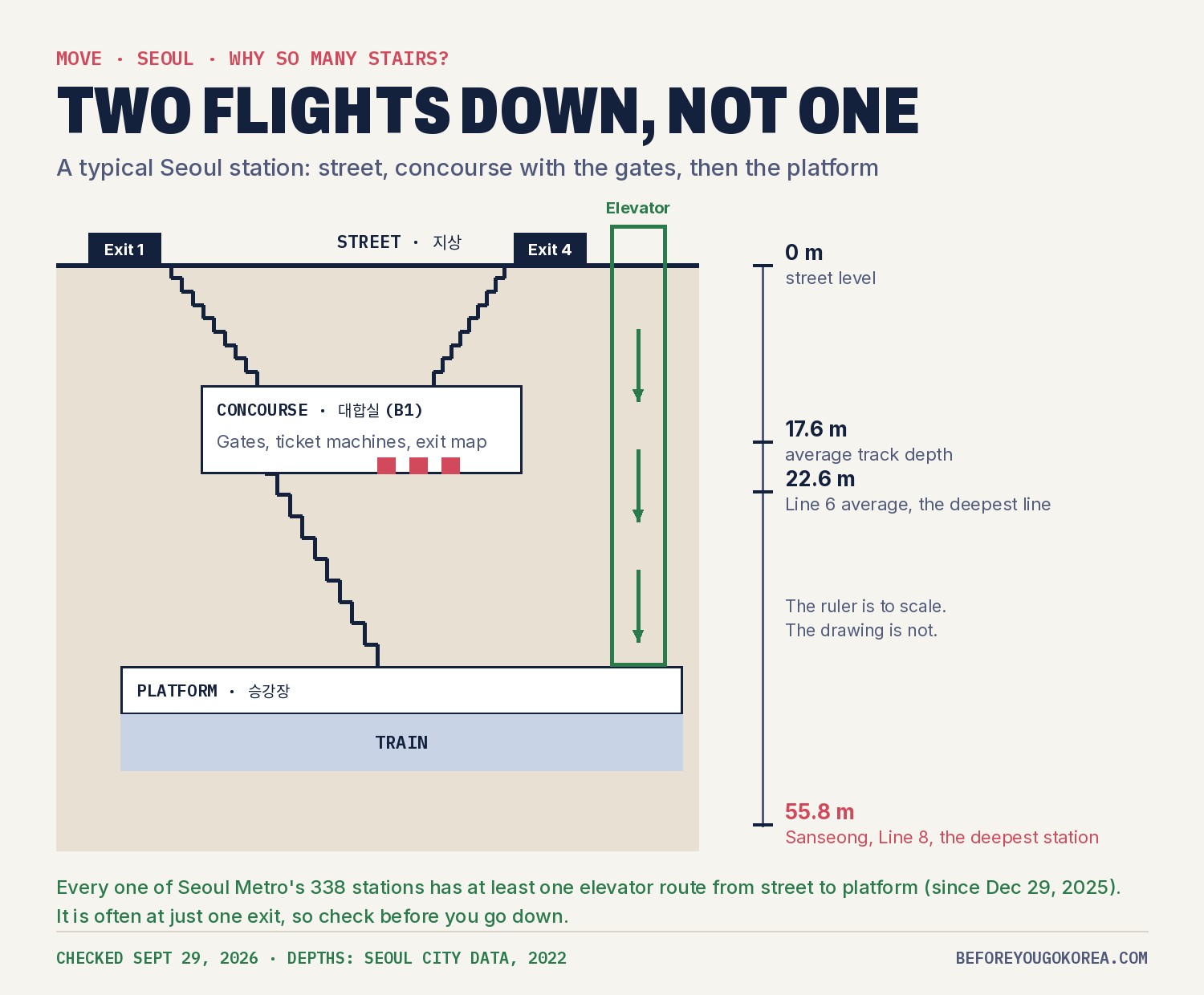
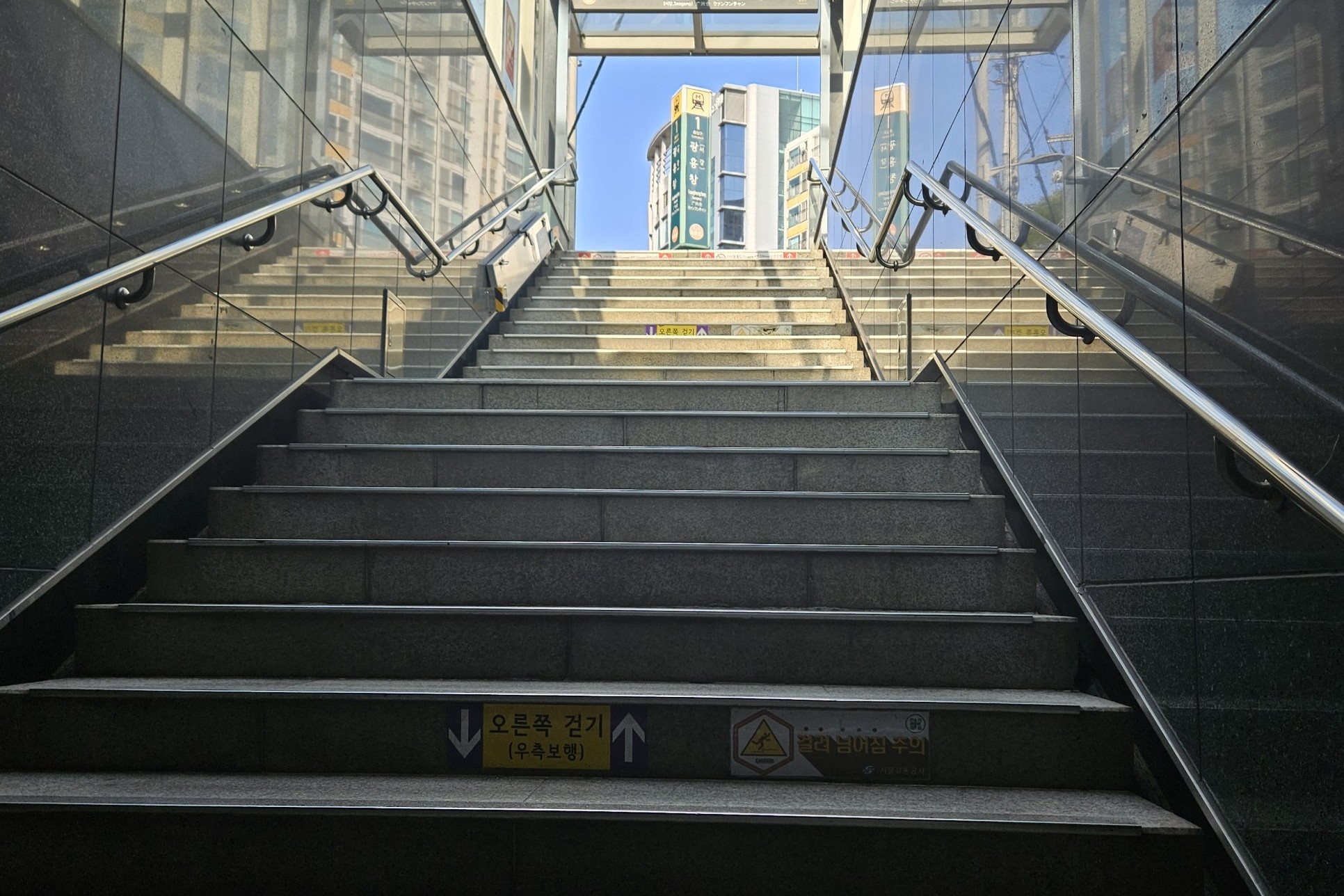
Mostly because you climb two flights, not one. Most Seoul stations have a middle level, the concourse, where the ticket gates are. You go down from the street to the gates, then down again to the platform. The trains aren't that deep on average: 17.6 m below ground. But some stations go much deeper. The deepest in Seoul, Sanseong on Line 8, is 55.79 m down.
The good news: since December 29, 2025, every one of Seoul Metro's 338 stations has at least one elevator route from the street to the platform. It's often at one exit only, so you have to know where it is.
Why does the Korean subway have so many stairs? I don't know why either.
Jump to: How deep is it? · Why two sets of stairs? · Why some stations are deep · Bomb shelters? · Is there an elevator? · How Seoul compares · Tips with luggage and strollers · FAQ
How deep is the Seoul subway?
Not as deep as it feels. Seoul's own transport data put the average depth of the tracks at 17.6 m. That's roughly a five- or six-storey building, standing on its head.
- Deepest line on average: Line 6, at 22.57 m.
- Deepest station: Sanseong (산성) on Line 8, at 55.79 m.
These figures come from Seoul's 2022 transport data, published in May 2023.
Why are there two sets of stairs?
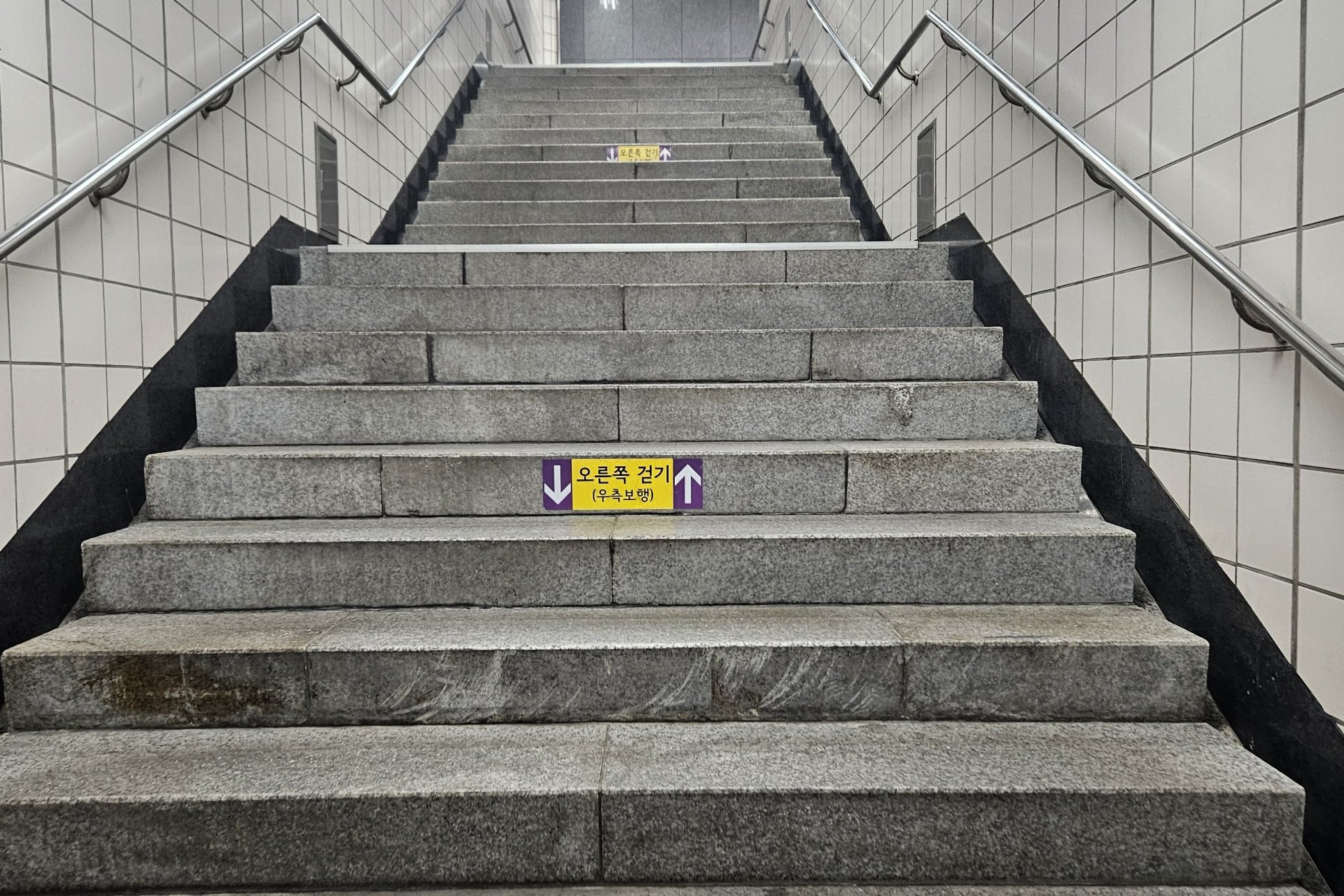
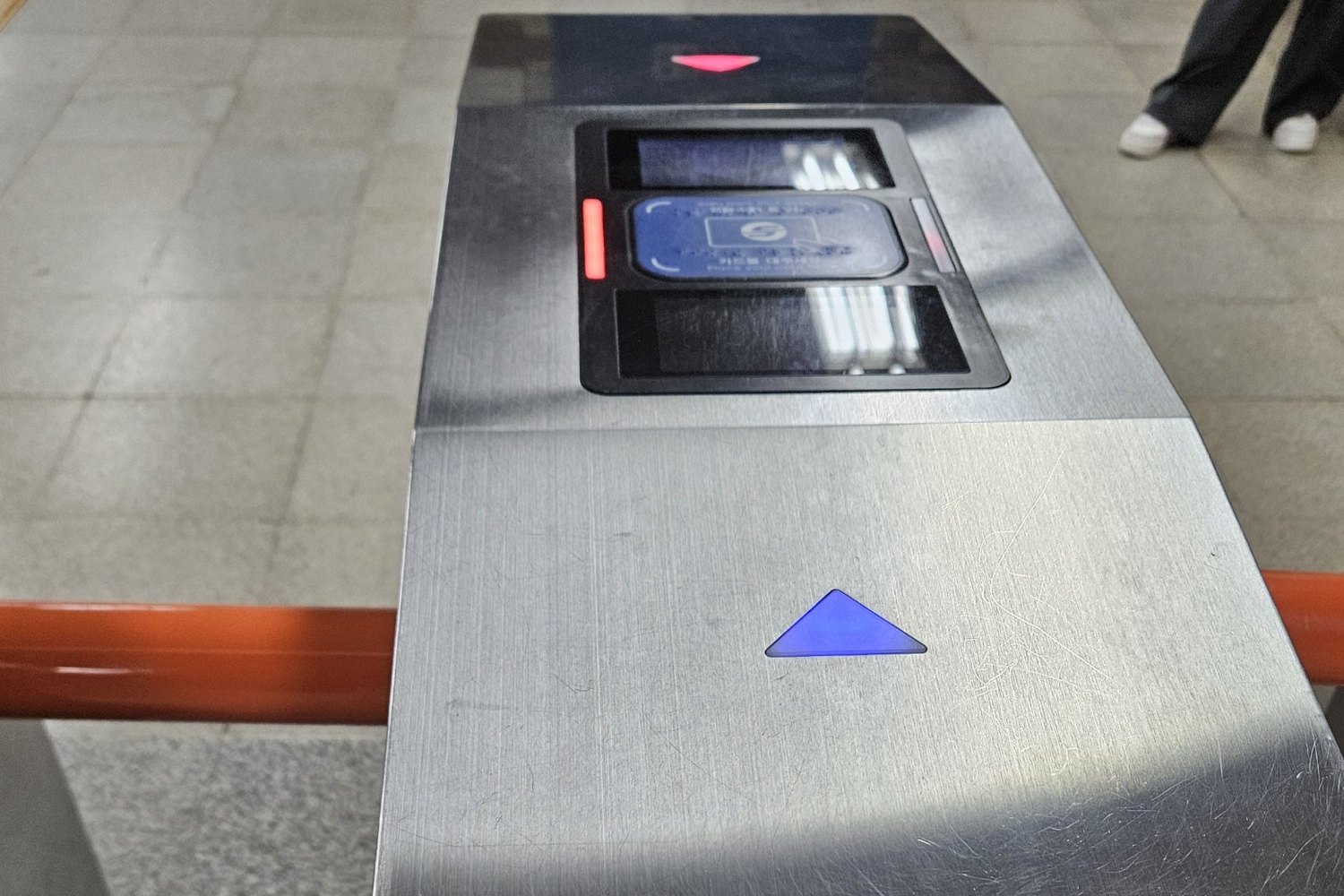
Most stations are built under a road. The platform runs along the road, and the exits come up on the pavements on both sides. In between is the concourse (대합실), usually one floor down. It holds the gates, the ticket machines and the exit map.
Korea's design rules for city rail stations ask for this spread of exits. At a crossroads they call for an entrance at each corner where possible. In the middle of a block, two per pavement. So from any exit you walk down to the concourse, tap in, then walk down again to the platform.
The same rules ask for up and down escalators "where possible". The oldest lines have far fewer of them, as you'll see below.
Why are some stations so deep?
The first lines were dug from the surface. Line 1 was built by opening up the road and covering it again, called cut-and-cover. It's the cheapest way at shallow depth, which is why the oldest lines are shallow.
Later lines were tunnelled. By the time Lines 5 to 8 were built in the 1990s, traffic was too heavy to keep digging up roads. More than 60% of their track was tunnelled instead. Line 5 also dives under the Han River twice. Tunnels go deeper, and so do their stations.
Other lines and hills get in the way. A line built later has to pass above or below the tunnels already there. And the track can't rise and fall with every hill the way a road does, so a station under high ground ends up far below the street.
Were Seoul's stations dug deep to be bomb shelters?
They are shelters, but that's not why they're deep. The city lists about 2,975 civil-defence shelters, and subway stations are among them, along with building basements and car parks.
I couldn't find any design rule or official record saying stations were built deep for that reason. The shallow old lines and the deep new ones point the other way: the depth follows the building method, the river, the hills and the lines already underground.
Is there an elevator at every Seoul subway station?
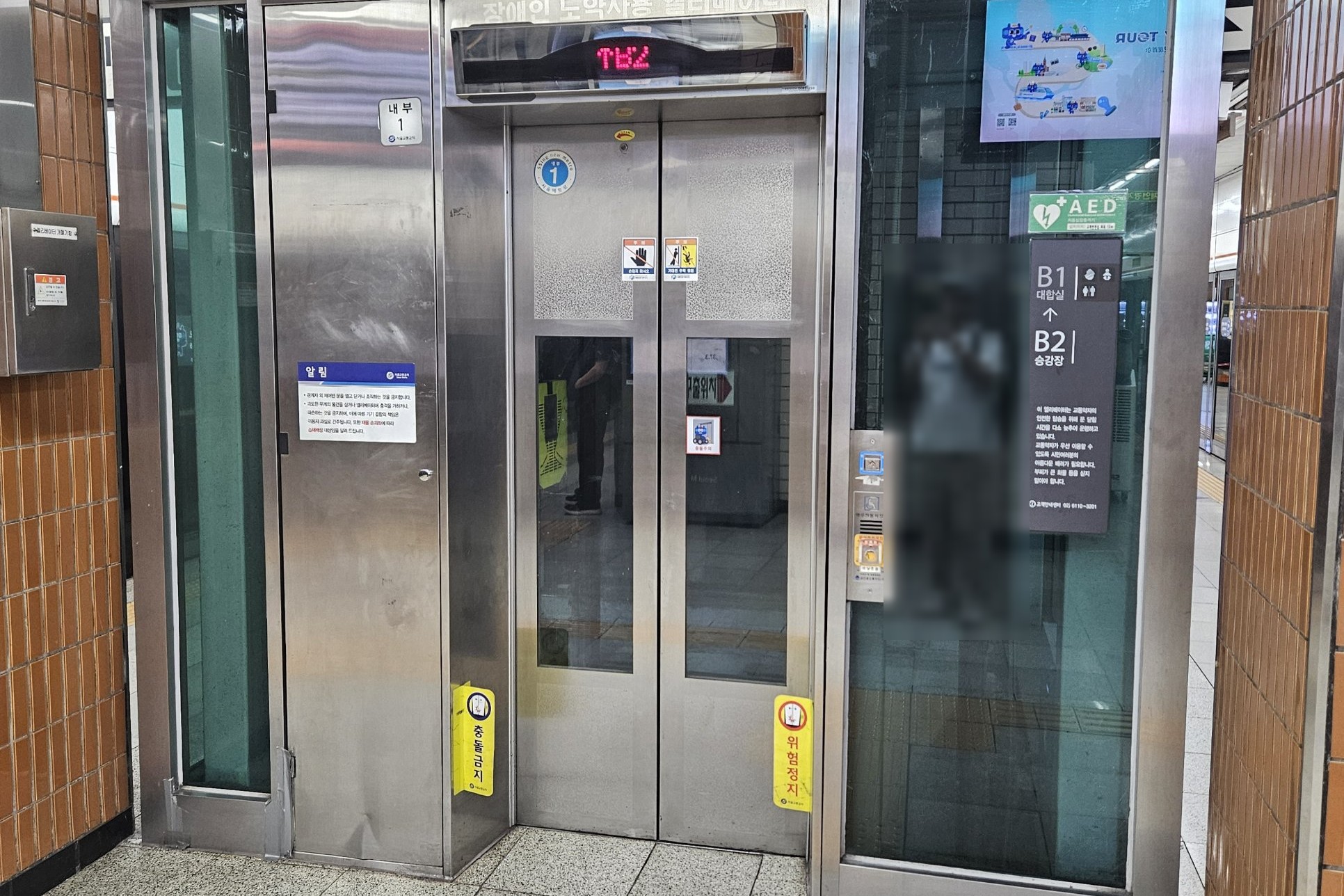
Yes, at least one route, on the Seoul Metro network. Seoul finished its "one station, one route" (1역사 1동선) programme on December 29, 2025. The last three stations were Sinseol-dong on Line 2, Express Bus Terminal on Line 7 and Kkachisan on Line 5. Kkachisan's platform is five levels down, and the builders had to cut through rock to fit the elevator.
Three limits to know:
- One route, not every exit. In May 2026 the Korea JoongAng Daily looked at Cheongnyangni on Line 1. Exit 1 has 70 steps and nothing else. From exit 6 you still face 35 steps to the platform. The step-free way in is exit 2, which means a detour along narrow pavements.
- Older lines have fewer lifts. The same report counted 7.2 elevators and escalators per station on Line 1, against 12.6 on Line 7.
- Transfers. At some stations, a wheelchair user still has to go up to the street and back down to change lines. Seoul plans shorter transfer routes at 13 big stations. At Konkuk University, the Line 2 to Line 7 change can take up to 35 minutes today for people with mobility needs.
How does Seoul compare with other cities?
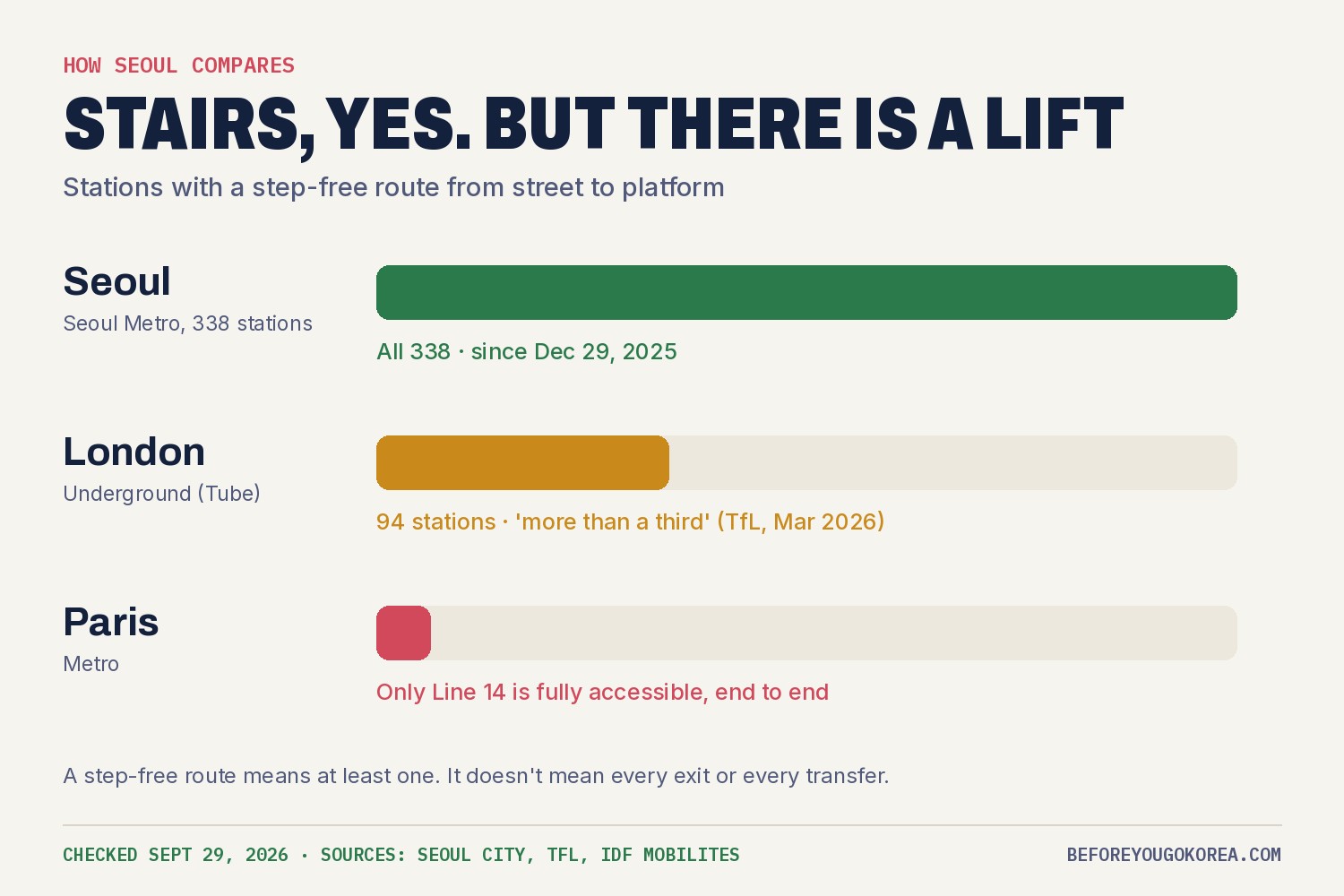
Not that many countries even have a subway. By one count, 214 cities in 63 countries run metro lines, as of May 2026.
Among those, Seoul does well on lifts, even if it's heavy on stairs:
- Seoul: all 338 Seoul Metro stations have a step-free route.
- London: 94 Tube stations are step-free, "more than a third", according to Transport for London in March 2026.
- Paris: only Line 14 is fully accessible from end to end. The operator says the rest of the 120-year-old network can't be fully adapted.
How do I get around with luggage or a stroller?
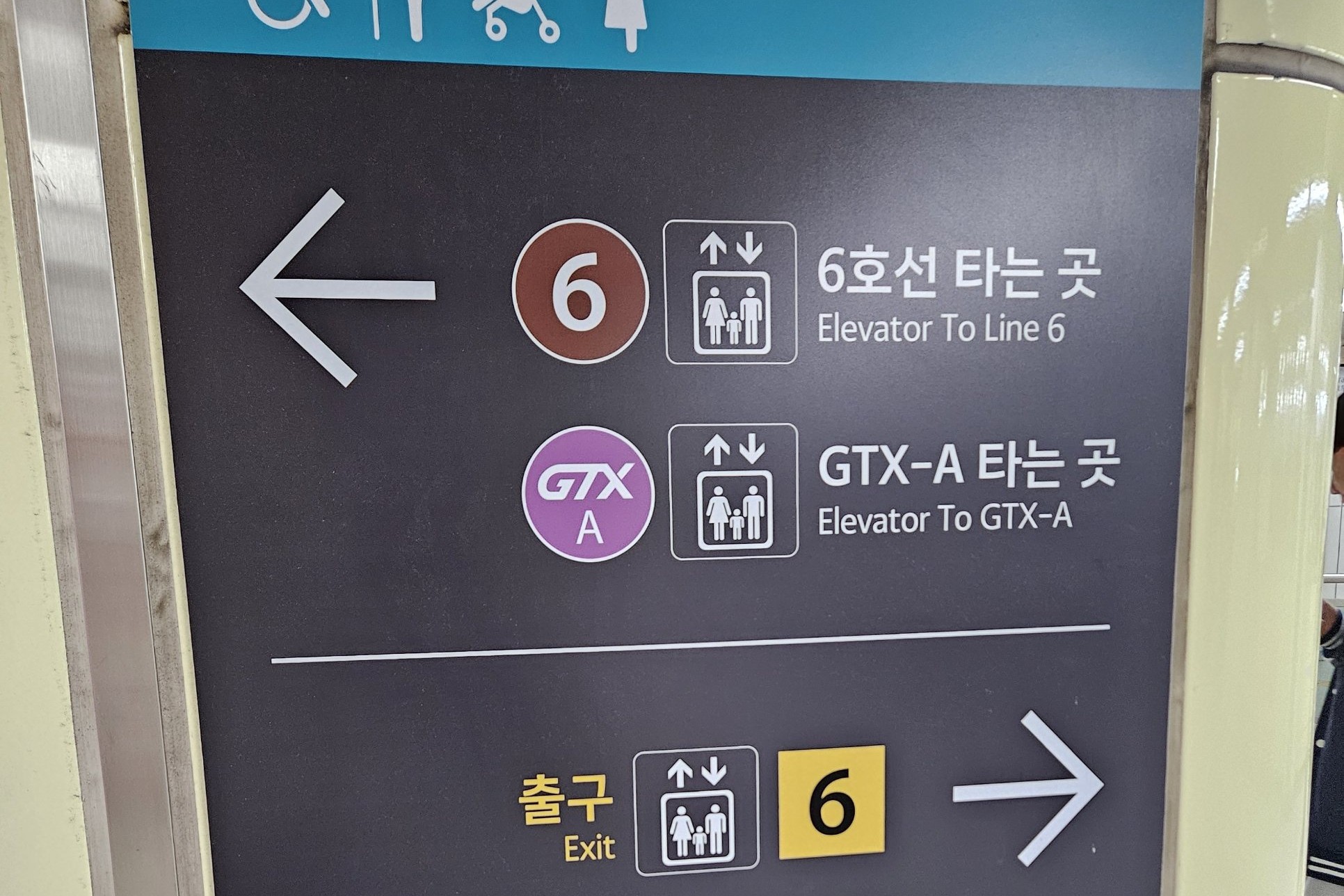
- Use Naver Map's "avoid stairs" option. Since August 2025, Naver Map's public transport directions can route you through entrances with elevators and suggest the car that stops nearest the lift. Naver says it works in English, Chinese and Japanese too.
- Plan the exit, not just the station. Check which exit has the elevator before you arrive, and pick a hotel near that exit if you'll carry bags every day.
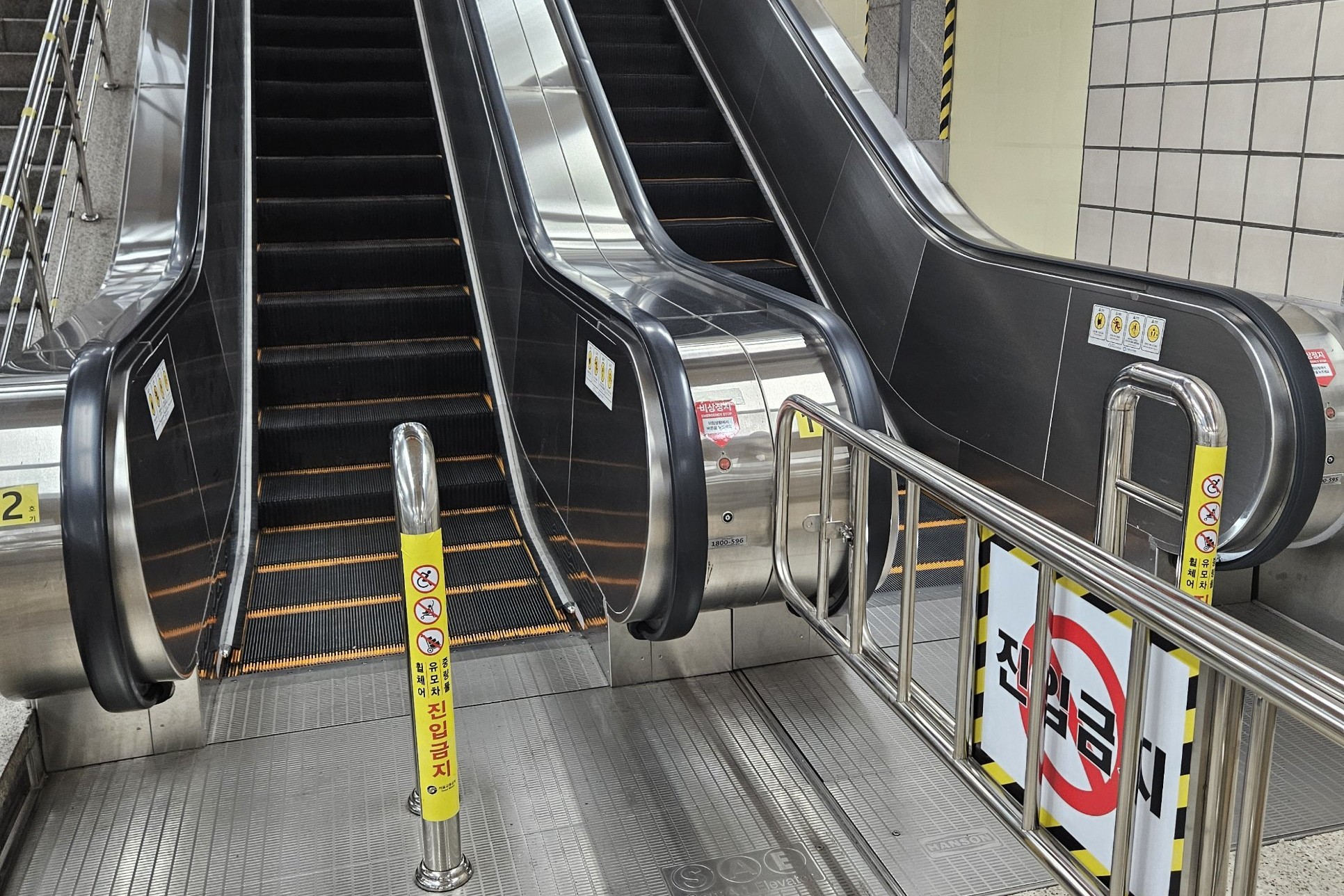
- Take the elevator, not the escalator. Seoul Metro asked people with suitcases and strollers to do exactly this in its September 2026 safety campaign. Escalator accidents on its network went from 44 in 2023 to 54 in 2024 and 102 in 2025. It says about 92% came from how people rode: not holding the handrail, or walking and running.
- Hold the handrail and stand still if you do take the escalator.
- Check for broken lifts. Seoul Metro's app, 또타지하철 (Seoul Subway), sends elevator status alerts and has an English version.
- Give big transfer stations extra time, and avoid rush hour with large bags.
FAQ
Why are there so many stairs in the Seoul subway?
Most stations have two levels to go down: from the street to the concourse with the gates, then to the platform. Exits sit on both sides of the road, and older stations had little room for escalators.
How deep is the Seoul subway?
17.6 m on average. The deepest Seoul station is Sanseong on Line 8, at 55.79 m.
Do all Seoul subway stations have elevators?
All 338 Seoul Metro stations have at least one elevator route from street to platform since December 29, 2025. Not every exit has one.
Can I use the Seoul subway with a big suitcase?
Yes. Use Naver Map's avoid-stairs option, find the elevator exit before you go, and use elevators rather than escalators.
Were Seoul subway stations built as bomb shelters?
Many are designated shelters today. I found no evidence they were dug deep for that reason.
Things I could not confirm:
- Exact depths from Seoul Metro's own station depth file. The figures above come from the city's 2022 data as reported in 2023.
- The exact names of all 13 stations in Seoul's shorter-transfer plan, and when each will be done.
- How lines run by other operators (Line 9, Korail lines, AREX) compare. The 338-station figure is for Seoul Metro.
- The exact label of Naver Map's avoid-stairs option in the English app. I haven't seen a screenshot of it.
If you really dig into it, I'm curious about it too. This is what I found in the Korean sources.
More on riding the Seoul subway and buses
Sources
- Seoul Metropolitan Government, elevator route at all 338 stations (Jan 9, 2026): mediahub.seoul.go.kr
- Kyunghyang Shinmun on Seoul's 2022 transport data, subway depths (May 10, 2023): khan.co.kr
- Tunnels and Tunnelling, "Underground construction in Korea" (Mar 1, 2001): tunnelsandtunnelling.com
- Ministry of Land, Infrastructure and Transport, urban rail station design guidelines (latest revision May 15, 2025): law.go.kr
- Seoul Metropolitan Government, civil-defence shelters (Mar 5, 2026): news.seoul.go.kr
- Korea JoongAng Daily, "The cursed 35 stairs" (May 27, 2026): koreajoongangdaily.com
- Financial News on the 10-minute transfer plan (Dec 29, 2025): fnnews.com
- The Fair News on Seoul Metro's escalator safety campaign (Sept 17, 2026): thefairnews.co.kr
- Asia Economy on Naver Map's avoid-stairs routing (Aug 1, 2025): asiae.co.kr
- 또타지하철 (Seoul Subway) app by Seoul Metro: App Store
- Transport for London on step-free Tube stations (Mar 26, 2026): tfl.gov.uk newsroom
- Île-de-France Mobilités on Paris metro accessibility: iledefrance-mobilites.fr
- Number of metro systems worldwide (as of May 16, 2026): Wikipedia
— SeoulAslan


Comments
Post a Comment