








 SetPaying for Seoul transport

 Hi, I’m SeoulAslan
Korea Travel Apps: Which You Need and Which to Skip (2026)
Checked Oct 6, 2026

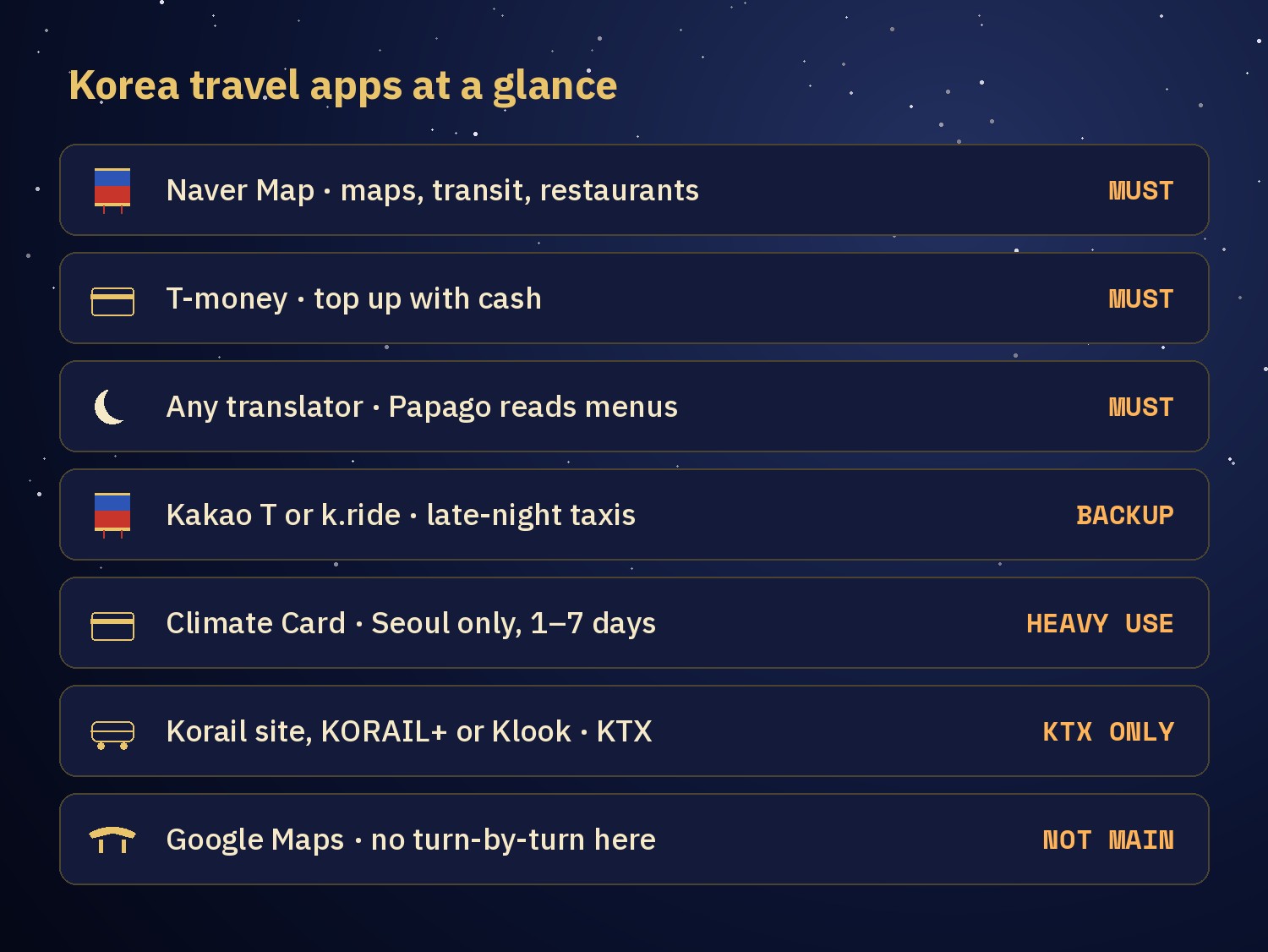
You need three things: Naver Map, a transit card (T-money, or a Climate Card if you ride a lot in Seoul), and any translation app. Kakao T is your late-night backup for taxis. KORAIL+ (the new name for Korail Talk) or Klook only matter if you're taking the KTX. Google Maps can stay on your phone, but don't make it your main map in Korea.
Someone on r/koreatravel asked today which of these apps and cards they really need. A local already answered well: Naver Map, T-money and Papago as must-haves, Kakao T and Korail Talk as nice-to-haves, the Climate Card only for heavy subway days. Below is what I'd add to it, with the foreigner catches checked against official pages.
Jump to: The full list · Naver Map · T-money · T-money or Climate Card? · Translator · Kakao T · KTX apps · FAQ
Which Korea travel apps do you actually need?
| App | What for | Need it? | Foreigner catch |
|---|---|---|---|
| Naver Map (네이버 지도) | Maps, subway and bus routes, walking directions, restaurants | Yes | Switch it to English. Sign-up offers passport verification |
| T-money card | Tap on subway and buses; also works in taxis and convenience stores | Yes (or a Climate Card) | Top up with cash. On iPhone, Apple Wallet T-money can be loaded with a foreign Mastercard |
| Climate Card short-term pass | Unlimited Seoul subway and buses for 1–7 days | Only if you ride a lot | Inside Seoul only. 3,000 won card. iPhone users need the physical card |
| Any translator (Papago, DeepL, etc.) | Menus, signs, talking to staff | Yes, any one | None. Papago is Naver's app and translates text in a photo |
| Kakao T / k.ride | Calling a taxi | Backup | Kakao T has an English menu. k.ride, Kakao's app for visitors, logs in with Google, Apple or email and takes foreign cards |
| KORAIL+ / Korail English site / Klook | KTX and other train tickets | Only if you take the train | Korail's English site works as a non-member with a foreign card |
| Google Maps | Backup, your saved places from home | Not as your main map | No turn-by-turn walking or driving directions in Korea |
Why Naver Map instead of Google Maps?
In my recent experience, Google Maps misses a lot of detail in Korea, both for restaurants and for directions. I went to Google to check reviews of a restaurant that had been open for three months, and it wasn't on Google Maps at all. I don't think any other country has a map service as detailed as Naver.
The directions part is not just my impression. Google itself says its walking and driving directions aren't offered in Korea. In August 2026 Google said it plans to bring full turn-by-turn navigation to Korea, but there's no launch date yet.
Naver Map runs in English, Japanese, Korean and Simplified Chinese. It has walking directions and subway and bus routes, and Naver added English, Chinese and Japanese for visitor reviews and place filters in 2024. I compared the three map apps side by side in Naver Map vs Kakao Map vs Google Maps, and how locals actually pick restaurants in How Koreans find local restaurants.
Do you really need a T-money card?
Yes, or something that does the same job. You tap it at the subway gate and on the bus, and the same card pays for taxis and at convenience stores. Seoul's subway base fare is 1,550 won with a transit card, plus 100 won for every extra 5 km past 10 km.
The catch is topping up. Seoul City says the station machines take credit cards only for single-journey tickets, commuter passes and the Climate Card short-term pass. Topping up a prepaid card is cash. T-money's own English guide says the same thing in softer words: don't count on a foreign card, cash is the reliable way. So keep some won on you. More on that in Do you need cash for Seoul transport?
- Buying one when you land: where to get T-money at Incheon Airport
- On an iPhone: since March 2026 the MobileTmoney app lets you load T-money in Apple Wallet with a foreign card, Mastercard included. The brands and steps are in T-money in Apple Wallet with a foreign card
- Tapping your own contactless card: what works on Seoul transit today
T-money or Climate Card: which one fits your plan?
T-money vs Climate Card really depends on how you plan your trip.
The Climate Card short-term pass is Seoul City's unlimited pass for the subway and Seoul buses, and it works inside Seoul only. Ride out to a city outside Seoul and you pay extra. It starts on the day you load it, so you can't load it in advance. You buy the 3,000 won card from the ticket machines at Line 1–8 stations, then load a pass. Since March 2026 the newer machines take foreign Visa and Mastercard cards, with a fee of about 3.7%.
| Pass | Price | Subway rides to break even (pass only) | With the 3,000 won card |
|---|---|---|---|
| 1 day | 5,000 won | 4 | 6 |
| 2 days | 8,000 won | 6 | 8 |
| 3 days | 10,000 won | 7 | 9 |
| 5 days | 15,000 won | 10 | 12 |
| 7 days | 20,000 won | 13 | 15 |
Calculated from the 1,550 won base fare. Longer rides cost more, so if you cross the city a lot you break even a bit sooner.
| Your plan | Pick | Why |
|---|---|---|
| Walking around one or two neighborhoods a day, 2–3 rides | T-money | You won't reach the break-even count |
| A packed Seoul day with 6 or more rides | Climate Card, 1 day | Even with the card fee it pays off |
| Day trips outside Seoul | T-money | The Climate Card covers Seoul only. Get off at a station outside Seoul and staff charge the extra fare |
| Shinbundang Line, GTX, airport buses | T-money | Not covered by the Climate Card |
| iPhone and you want to pay with your phone | T-money in Apple Wallet | The mobile Climate Card is Android only |
The full rules, refunds included, are in Seoul Climate Card tourist pass explained, and the three-way comparison with WOWPASS is in T-money vs Climate Card vs WOWPASS.
Do you need Papago, or will any translator do?
Translation apps are all good these days, so it doesn't have to be Papago. Any of them is fine.
Papago, Google Translate, DeepL: use whichever you already have, as long as it handles Korean.
If you do pick Papago, it's made by Naver. It translates the text in a photo, which is handy for menus, and it has offline text translation.
Do you need Kakao T?
Kakao T is for emergencies. In Korea, if public transport has stopped, you can just take a taxi. In Rome I couldn't get an Uber at all in the small hours, or even early in the morning, and it was a real problem.
Kakao T is the app most Koreans use to call a taxi, and it runs in English. Kakao also makes k.ride just for visitors: you log in with Google, Apple or email, pay with a foreign card, and chat with the driver through auto-translation. Uber works too, for licensed taxis. Taxis themselves take foreign cards, T-money and cash.
- Which app to use, and how to pay: Can you use Uber in Korea?
- What a ride costs, night surcharges included: Seoul taxi fares
- When the subway stops: Getting around Seoul after midnight
Korail Talk or Klook for KTX tickets?
Skip both if you aren't leaving Seoul by train. If you are, there are three ways:
- Korail's English website (korail.com/global/eng). You can book as a non-member with an email and a password and pay with a foreign card. It's Korail's own site, in English.
- KORAIL+, the app that used to be called Korail Talk. It was renamed in an August 2026 update, ahead of KTX and SRT merging under one name on Sept 1.
- Klook. Since April 2026 it sells Korail tickets in real time through a partnership with Korail, and you board with a mobile voucher.
The whole booking walk-through, with the new two-months-ahead booking window, is in How to book KTX as a foreigner.
FAQ
Which map app should be my main one?
Naver Map. Google Maps has no turn-by-turn walking or driving directions in Korea, and new places can be missing.
Is the Climate Card worth it for tourists?
Only on heavy days inside Seoul, since it doesn't cover cities outside Seoul. A 1-day pass needs 6 subway rides to beat T-money once you count the 3,000 won card.
Do I need Kakao T if I have Uber?
Not strictly. Uber calls licensed taxis in Korea. Kakao T or k.ride is the backup if Uber can't find you a car.
Do I need Klook to book the KTX?
No. Korail's English site sells the same trains directly, and you can book as a non-member.
For topping up T-money, see our guide to paying cash and card on Seoul transport.
When Google adds full navigation
Google has said it plans full navigation for Korea. When that launches, the Naver-vs-Google advice could change, and I'll update this page. I'm also watching whether foreign contactless cards on Seoul transit make carrying cash for T-money less necessary.
Sources
- Seoul City: Climate Card short-term pass (Korean) · Seoul City: paying by card at station kiosks, Sept 30, 2026 (Korean)
- Korea JoongAng Daily: overseas cards at Seoul subway machines, March 2026
- Seoul City: subway fares (Korean)
- T-money: using T-money at convenience stores · Mastercard, Apr 9, 2026
- Google Korea blog: Google Maps in Korea Q&A (Korean) · The Investor: Google plans turn-by-turn navigation
- NAVER: Naver Map for foreign users, Dec 30, 2024 · Naver Map, Papago and Kakao T App Store listings
- Kakao Mobility: k.ride · T-money Mobility: taxi card terminals (Korean)
- Korail: KORAIL+ launch (Korean) · VisitKorea: Klook x Korail train booking · Korail English site
— SeoulAslan


Comments
Post a Comment