




 SetPaying for Seoul transport
 Hi, I’m SeoulAslan
Seoul Taxi Fares and Tips for Visitors (2026)
Checked Sept 29, 2026
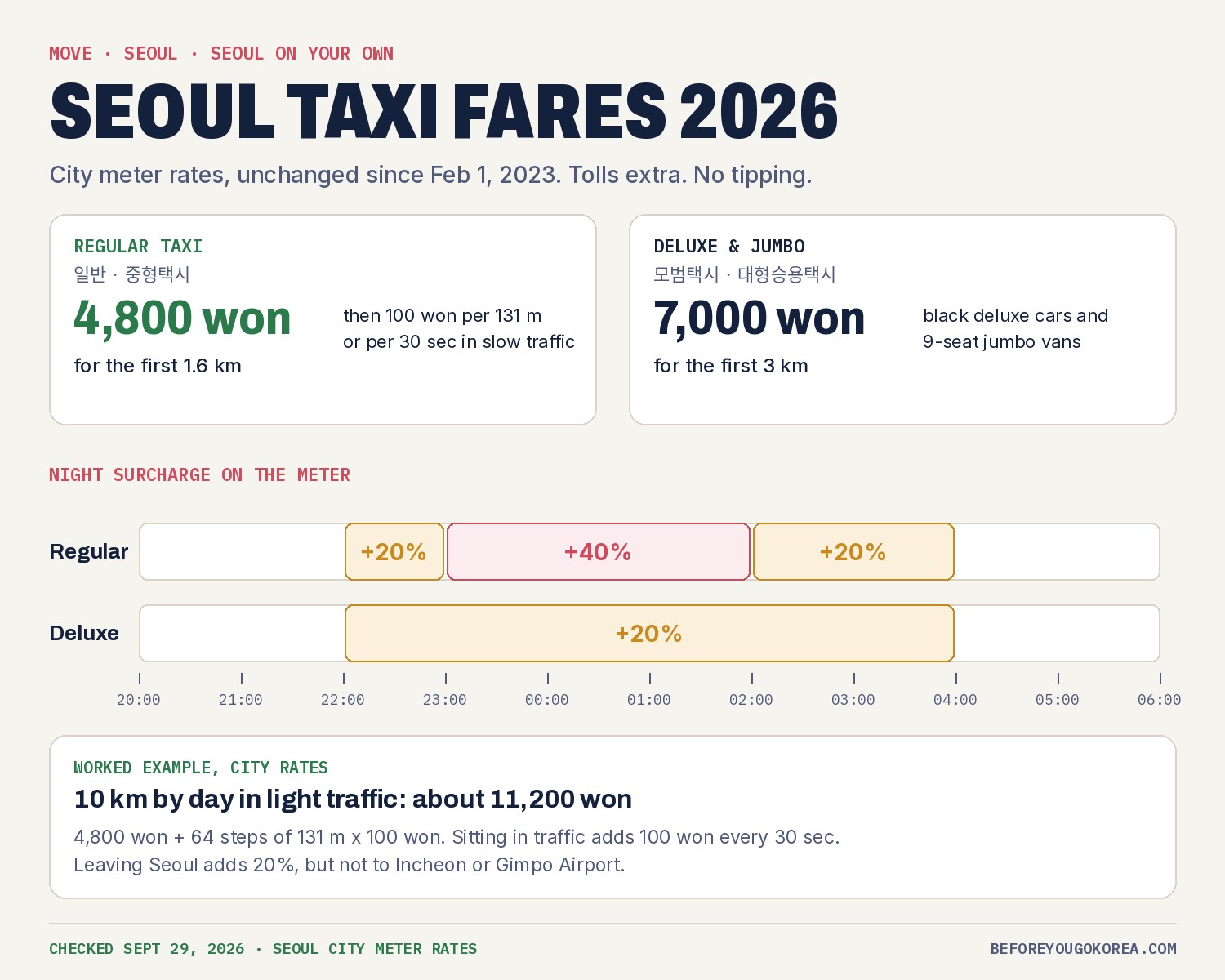
A regular Seoul taxi starts at 4,800 won for the first 1.6 km, then adds 100 won every 131 m, or every 30 seconds when the car is crawling. From 23:00 to 02:00 the meter runs 40% higher, and 20% higher from 22:00 to 23:00 and 02:00 to 04:00. Deluxe (모범) and jumbo taxis start at 7,000 won. Foreign Visa and Mastercard work in the taxi, and there's no tipping. These fares haven't changed since February 1, 2023.
I call Kakao T even when I'm sending my elderly parents off in a taxi. Whichever way you catch a cab in Seoul, the regular ones run on the same city meter, so here is what it charges and how to pay it.
Jump to: How much · Night surcharge · Deluxe and jumbo · Paying · Airport taxis · Apps · Showing the address · FAQ
How much does a taxi cost in Seoul?
| Taxi | Korean | Starts at | Night surcharge |
|---|---|---|---|
| Regular (midsize) | 일반 · 중형택시 | 4,800 won for 1.6 km | +20% or +40%, 22:00–04:00 |
| Deluxe | 모범택시 | 7,000 won for 3 km | +20%, 22:00–04:00 |
| Jumbo (9 seats) | 대형승용택시 | 7,000 won for 3 km | +20%, 22:00–04:00 |
After the first 1.6 km, a regular taxi adds 100 won for every 131 m. When it's moving slowly, it adds 100 won for every 30 seconds instead. So traffic costs you money even when you barely move.
A worked example with the city's rates: 10 km by day in light traffic is about 11,200 won. That's 4,800 won plus 64 steps of 131 m at 100 won each. Real rides usually come out a little higher once you hit lights and jams.
Leaving Seoul adds a 20% out-of-city surcharge. Trips to Incheon Airport and Gimpo Airport don't pay it. Highway tolls are extra, and you pay them.
What are the night surcharge hours?
- 22:00 to 23:00: +20%
- 23:00 to 02:00: +40%
- 02:00 to 04:00: +20%
For a regular taxi, the night and out-of-city surcharges together are capped at 60%. Deluxe and jumbo taxis add a flat 20% from 22:00 to 04:00, capped at 40% with the out-of-city surcharge.
Late at night in nightlife areas, an empty taxi can be hard to find. That's also when the meter is at its highest, so if you can leave before 23:00, you save twice.
What are deluxe and jumbo taxis?
Deluxe taxis (모범택시, mobeom) are usually black, with more room and experienced drivers. Jumbo taxis (대형승용택시) are 9-seat vans, good for a family or a lot of luggage. Both start at 7,000 won for the first 3 km.
At Incheon Airport they have their own stands: 7C and 8C at T1, 7D at T2. In the city you can also book a deluxe taxi in Uber or k.ride.
Can I pay for a Seoul taxi with a foreign card?
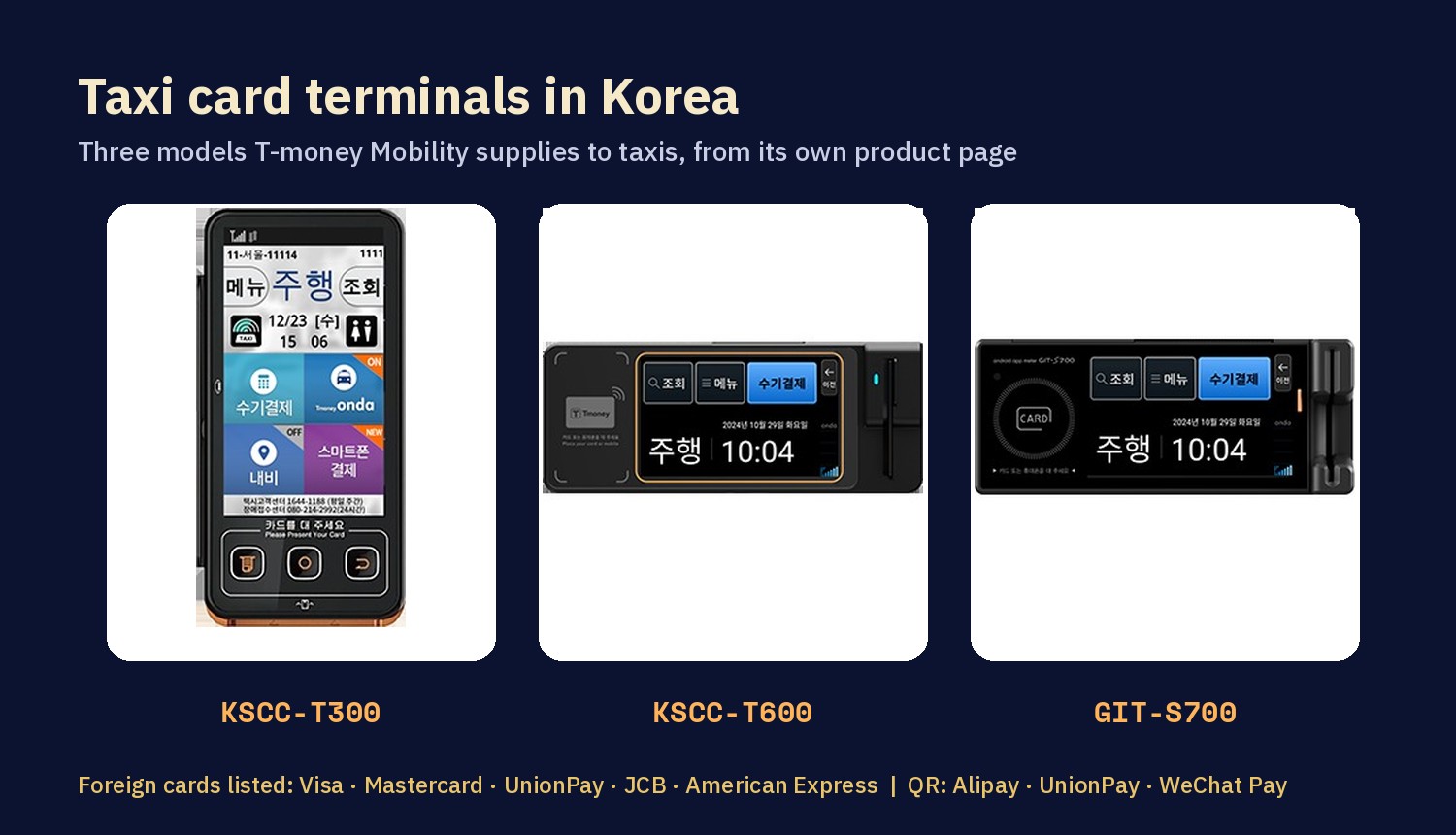
Yes. T-money Mobility's taxi card terminal lists Visa, Mastercard, UnionPay, JCB and American Express, plus Alipay, WeChat Pay and UnionPay QR codes. You can also pay with:
- T-money: the same transit card you use on the subway. On an iPhone, T-money in Apple Wallet works too.
- Cash: Korean won.
- An app: Uber with your home card, or k.ride with a foreign card.
When I plan a trip abroad, two of my five checks are whether cards work and whether I can just tap. In a Seoul taxi, cards work. Tapping a contactless card or phone usually works too, travellers say, but the terminal maker's page only lists card brands and doesn't mention tapping. If a tap fails, insert the card.
Get a receipt (영수증 주세요, yeongsujeung juseyo). It shows the taxi's number, which you need to report a problem or find a lost bag. Seoul City said in January 2026 that it had been working with T-money Mobility since December to print the fare, boarding time and surcharges in English on receipts.
Tipping: none. The meter price is the price.
How do I avoid being overcharged from the airport?
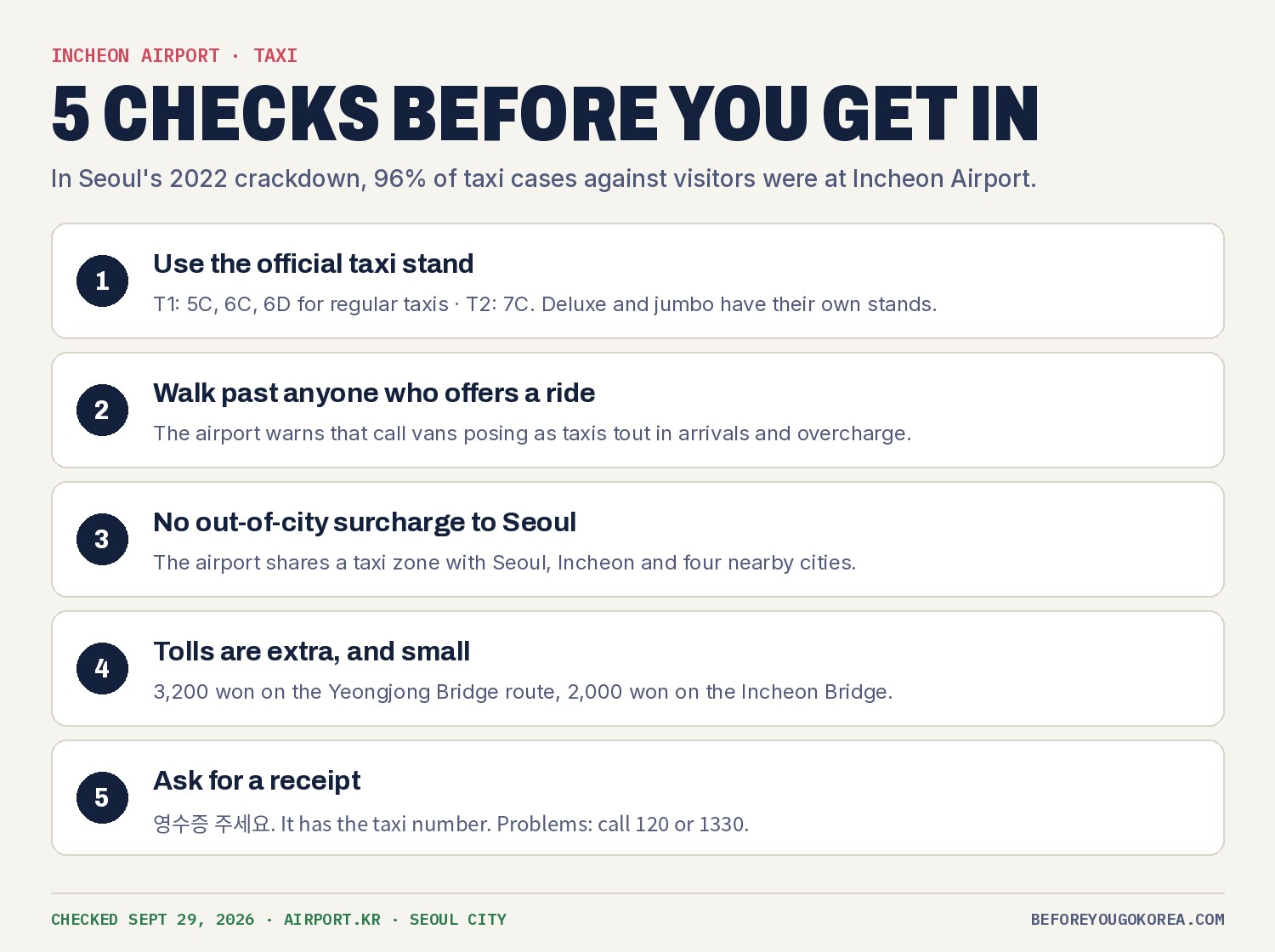
Airport trips are where visitors get overcharged most. In Seoul's 2022 crackdown, 96.3% of the illegal taxi cases it caught against foreigners were at Incheon Airport, and most were overcharging. In 2024, city inspectors interviewed 7,435 visitors and found 345 violations.
- Use the official stand on the arrivals floor. Regular taxis wait at 5C, 6C and 6D at T1, and at 7C at T2.
- Walk past anyone offering a ride. The airport warns that call vans posing as taxis tout in arrivals and overcharge.
- Know there's no out-of-city surcharge to Seoul. The airport shares a taxi zone with Seoul, Incheon and four nearby cities. An extra 20% on a trip to Seoul is wrong.
- Expect a small toll. The Yeongjong Bridge route costs 3,200 won at the Incheon Airport tollgate. The Incheon Bridge costs 2,000 won since December 18, 2025, down from 5,500. Guides that still quote 6,600 or 5,500 are out of date.
- Watch the meter and keep the receipt.
Gimpo isn't immune. In January 2026 the city described a Gimpo Airport driver who charged a visitor 56,000 won for a ride that metered 32,600 won.
To report a problem: call 120 (Seoul's Dasan call centre) or 1330 (Korea Travel Hotline, English available). Since June 19, 2025, Seoul also hands out cards with a QR survey in English, Chinese and Japanese in the departure areas at Incheon and Gimpo.
A fixed price instead: the International Taxi (drivers who speak English, Japanese or Chinese) charges flat airport fares by zone: 70,000 to 95,000 won for a midsize car, 100,000 to 140,000 won for a large one. Book at least 24 hours ahead on the website or at 1644-2255. In the city it runs on the meter plus 20%.
Should I use Kakao T, k.ride or Uber?
Any of them works, and a regular taxi booked in an app still runs on the city meter. The differences are in the extras:
- Kakao T: what locals use. Kakao T Blue, which is dispatched automatically, adds a call fee. The app shows any fee before you confirm.
- k.ride: Kakao's app for visitors, with sign-up by Google, Apple or email. Its terms for Korea add a 10% service fee on every car type, as of Sept 29, 2026.
- Uber: your home app and card. Standard Taxi is on the meter. Extras such as Speed Call cost more.
How to set each one up, and why Korea has no Grab, is in Can you use Uber in Korea?
How do I show the driver where I'm going?
Many drivers speak little English, and hotel names in English often don't match what they know. Before you get in:
- Find the place on Naver Map or Kakao Map and copy the Korean name and address.
- Keep it on your screen in large text and show it as you get in.
- For a hotel, the Korean name matters more than the English one.
- For a big building, add the nearest subway exit (for example 홍대입구역 9번 출구, Hongik Univ. Station exit 9).
| Korean | Say it | Means |
|---|---|---|
| 여기로 가 주세요 | yeogiro ga juseyo | Please go here (show your screen) |
| 카드 돼요? | kadeu dwaeyo? | Can I pay by card? |
| 여기서 세워 주세요 | yeogiseo sewo juseyo | Please stop here |
| 영수증 주세요 | yeongsujeung juseyo | Receipt, please |
| 트렁크 열어 주세요 | teureongkeu yeoreo juseyo | Please open the trunk |
FAQ
What is the base fare for a Seoul taxi in 2026?
4,800 won for the first 1.6 km in a regular taxi, and 7,000 won for the first 3 km in a deluxe or jumbo taxi.
What time does the Seoul taxi night surcharge start?
At 22:00. It's +20% until 23:00, +40% from 23:00 to 02:00 and +20% again until 04:00.
Can I pay a Seoul taxi with Visa or Mastercard?
Yes, on the card terminal in the taxi. T-money and cash work too.
Do you tip taxi drivers in Seoul?
No.
Is there a surcharge from Incheon Airport to Seoul?
No out-of-city surcharge. You pay the meter, any night surcharge and the toll.
Things I could not confirm:
- Deluxe and jumbo distance rates. Seoul's main taxi fare page says 200 won per 151 m or 36 seconds; another city page says 100 won.
- Whether every taxi terminal accepts a contactless tap, or Apple Pay with a foreign card.
- Kakao T Blue's current call fee. The app shows it before you confirm.
- Whether all taxis already print English receipts. The city described the work in January 2026.
- Whether the International Taxi's flat airport fares include tolls.
- A Seoul fare rise. Korean media have discussed one, but the city hadn't announced any as of Sept 29, 2026.
It works just like Uber or Grab: Kakao T is how Koreans call a cab. But you don't need any app for the fare to be fair. The meter runs on the same city rates whichever way you catch the taxi.
More on airport rides, taxis and late nights
Sources
- Seoul Metropolitan Government: Seoul taxi fares (fares from Feb 1, 2023; page updated April 3, 2026), fare decision, fare table, QR reporting and enforcement (July 2, 2025)
- Incheon Airport: taxi information and English taxi page
- Edaily, Dec 22, 2022: Seoul's 2022 crackdown figures
- Asia Economy, Jan 20, 2026: English receipts, tolls shown separately, the Gimpo case
- Tolls: Incheon Airport Expressway toll table; Incheon Today, Dec 16, 2025
- T-money Mobility, taxi card terminal
- k.ride terms for Korea, read Sept 29, 2026
- International Taxi flat fares
- Hankyung, April 1, 2026: talk of a fare rise
— SeoulAslan


Comments
Post a Comment