
Korea Fall Foliage 2026: When Seoraksan and Naejangsan Actually Peak
Checked Sept 24, 2026
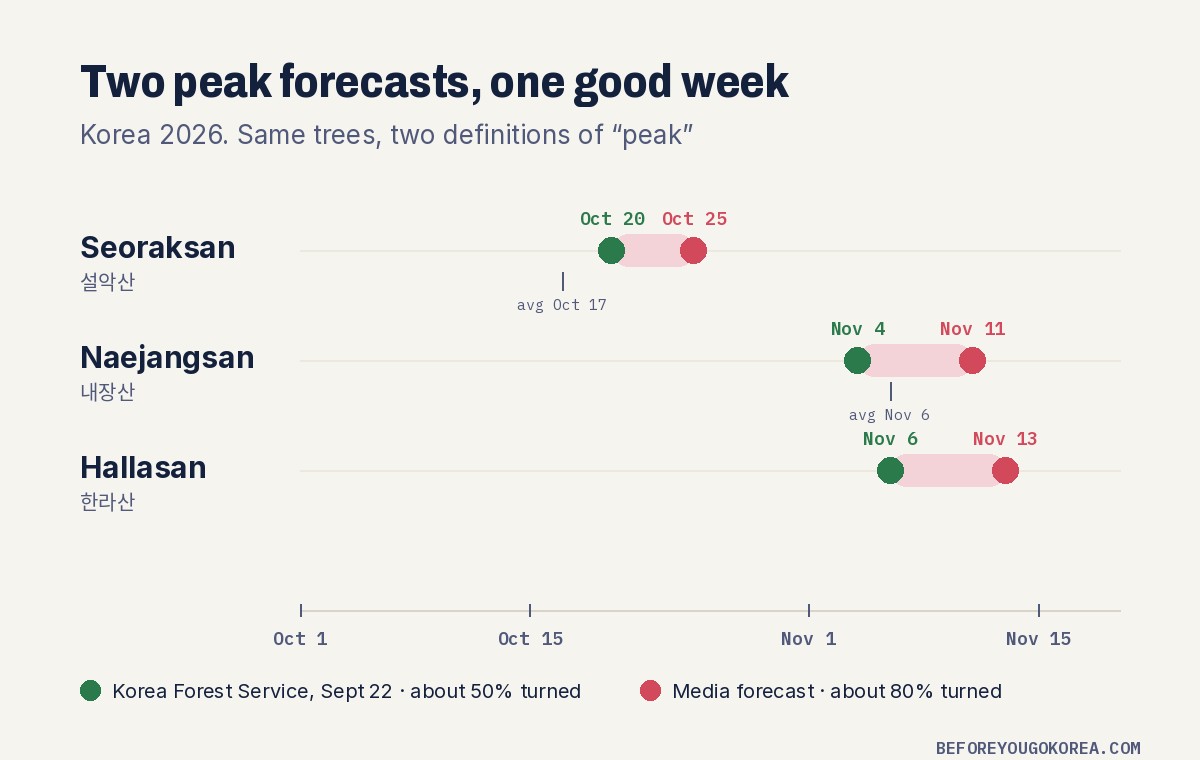
Two forecasts for Korea's 2026 autumn colours are out, and they don't agree. The Korea Forest Service puts Seoraksan's peak on Oct 20 and Naejangsan's on Nov 4. The forecast most Korean media repeated in early September says Oct 25 and Nov 11. Neither is wrong. They measure "peak" differently, and that one detail decides which weekend you should book.
I should say this up front: I really don't like crowds. So I have never seen Seoraksan on its true peak weekend. I always go a little after it, and that habit is why I started reading these forecasts closely.
Jump to: Why two dates · What is official · First colour to peak · Why Naejangsan is later · Which weekend · Getting there · FAQ
Why there are two peak dates
On Sept 22, 2026 the Korea Forest Service (산림청) published its peak map. It defines peak as the point when about 50% of the trees it watches have turned. Its dates:
- Seoraksan: Oct 20
- Songnisan: Oct 28
- Naejangsan: Nov 4
- Hallasan: Nov 6
The forecast that went round Korean news in early September uses the weather-service definition instead: peak is when about 80% of the whole mountain has turned. That is a later moment, so the dates are later:
- Seoraksan: first colour Oct 3, peak Oct 25
- Bukhansan (Seoul): first colour Oct 23, peak Nov 4
- Naejangsan: peak Nov 11
- Hallasan: first colour Oct 31, peak Nov 13
Read them as the start and the end of the good week. From about 50% to about 80% is when a mountain looks its best. After 80% the top starts to go brown.
What is official and what is a forecast
This surprised me. Korea's weather agency, the KMA (기상청), watches 21 well-known mountains, but it only reports first colour: the day the top 20% of a mountain has turned. It does not observe or announce peak. Its rule of thumb is that peak comes about 20 days after first colour.
So any "peak date" you read online is a forecast, either from the Forest Service or from a private weather company. Here is what the KMA itself has on record for Seoraksan:
- Average year: first colour Sept 28, peak Oct 17
- 2024: first colour Oct 4, peak Oct 29
- 2025: first colour Oct 2
2026 is running late. Both forecasts put Seoraksan well after its Oct 17 average, because September and October are expected to stay warmer than usual.
From first colour to peak: 19 to 25 days
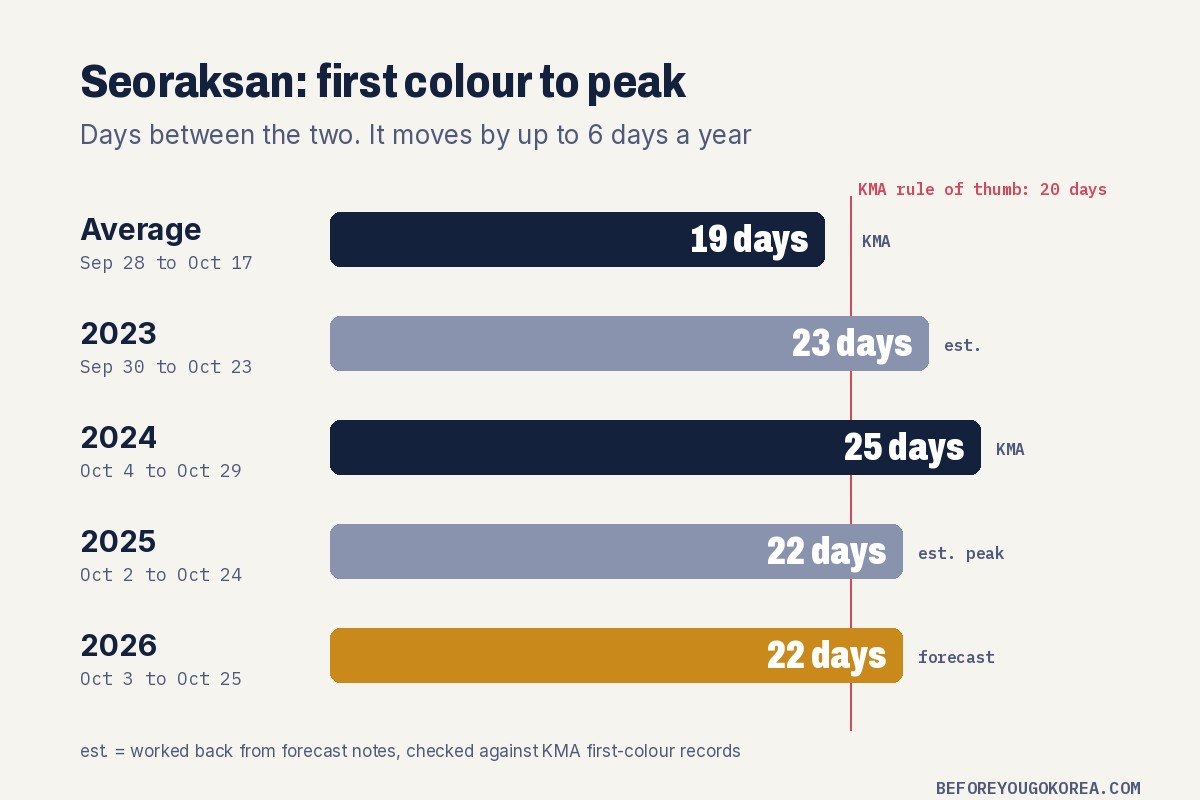
I counted the gap for Seoraksan, year by year:
- Average: Sept 28 to Oct 17, 19 days
- 2023: Sept 30 to Oct 23, about 23 days (worked back from forecast notes)
- 2024: Oct 4 to Oct 29, 25 days (KMA)
- 2025: Oct 2 to about Oct 24, about 22 days
- 2026 forecast: Oct 3 to Oct 25, 22 days
That is a six-day swing on the same mountain. So when the KMA announces Seoraksan's first colour in early October, you still can't pin peak to one day. Give yourself a window.
When I went. The last time I went up Seoraksan, it was a little after the announced peak, and I climbed all the way to the top. Up high, the colour goes fast. Maybe it was the heat. That autumn, two years ago, stayed warm for a long time, and near the summit the leaves had already burned out and fallen. There was almost nothing left to see.
That is the real lesson of the numbers above. "Peak" on the mountain is not one date. The top is finished while the valleys are just getting going.
Why Naejangsan peaks three weeks later
"It's further south" is only half the answer. On average Naejangsan peaks on Nov 6, 20 days after Seoraksan.
- Seoraksan: 38.1°N, highest peak Daecheongbong 1,708 m
- Naejangsan: 35.4°N, highest peak Sinseonbong 763 m
The colour moves south at about 20 to 25 km a day. That figure comes from Korean private forecasters, not the KMA. The two mountains are about 300 km apart north to south, which explains 12 to 15 days. The other 5 to 8 days are my guess at the effect of height. Seoraksan is more than twice as tall, and high ground turns first.
Which weekend to go
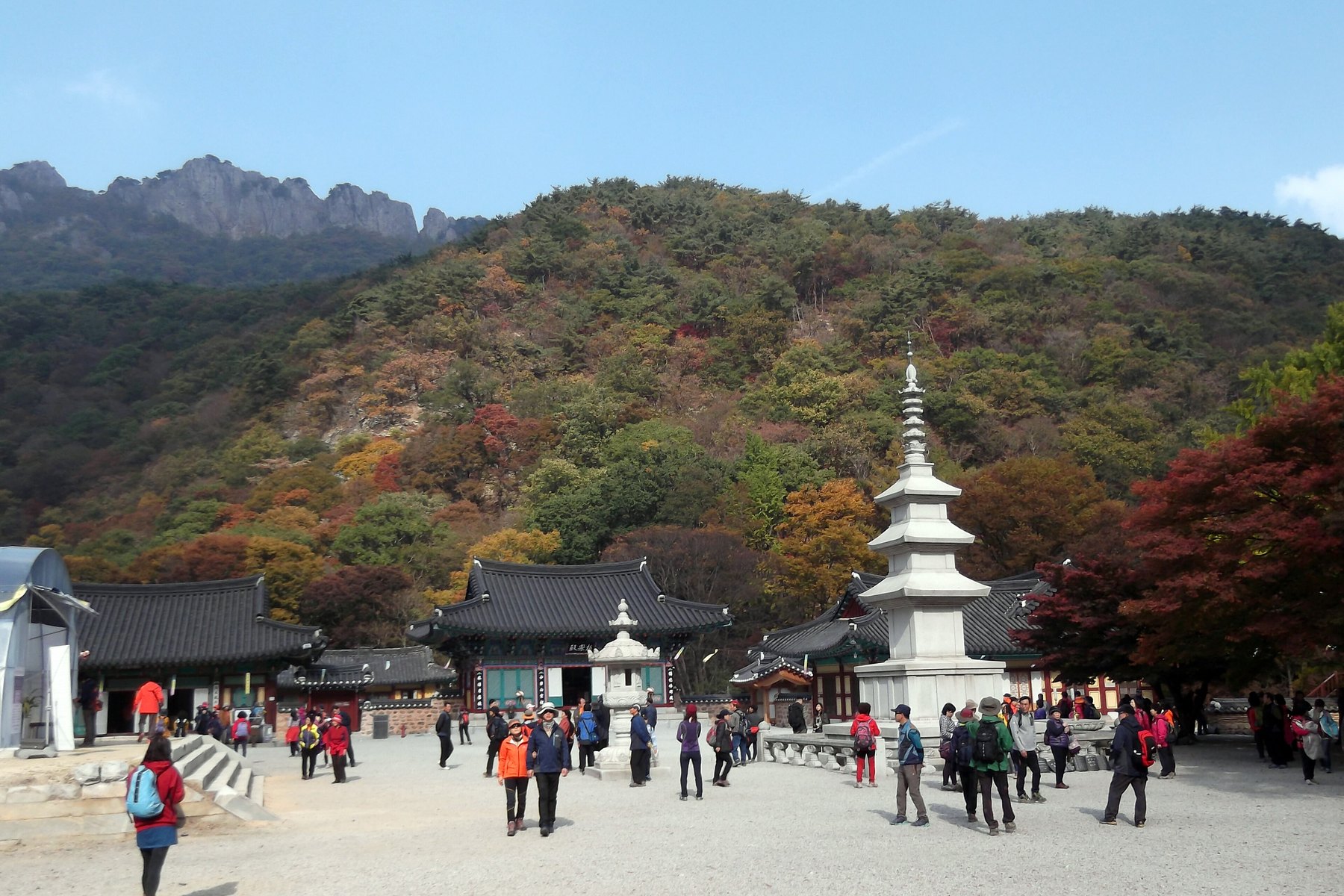
Seoraksan: aim for Oct 18 to 27. The high trails go first, so earlier in that window hike up high. Later in the window the lower valleys, like the walk to Biseondae or around Sinheungsa temple, are still good.
Naejangsan: aim for Nov 1 to 12. Naejangsan is famous for the maple tunnel on the way to Naejangsa temple, which is low, so it holds its colour later than a high summit would.
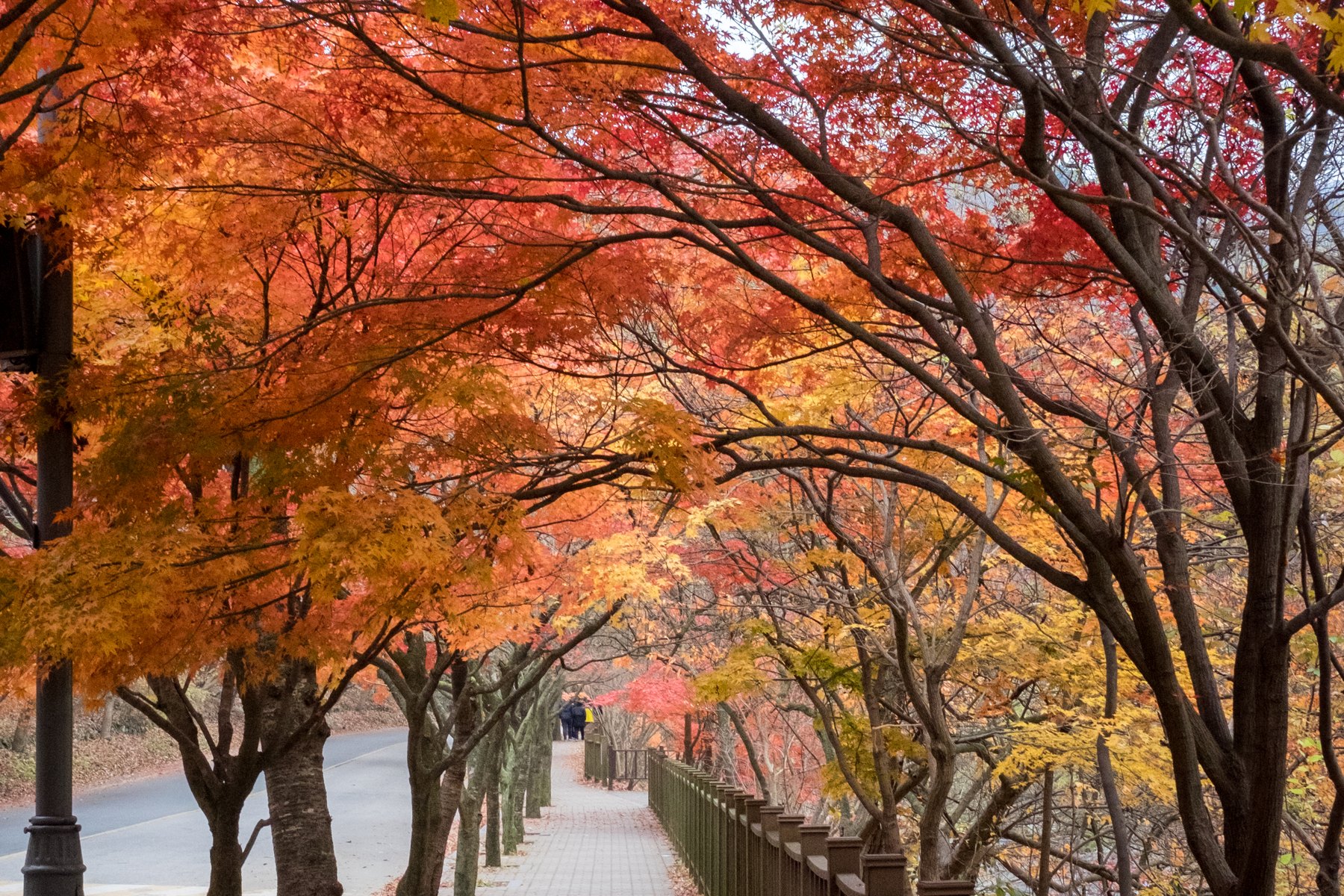
Crowds: the weekend of Oct 24–25 sits inside both Seoraksan forecasts. Expect heavy traffic on the road into Seorak-dong and full buses. If you can, go on a weekday.
Why I still go every autumn
The most beautiful maple I have ever seen wasn't on a mountain. It was a single tree inside Gyeongbokgung Palace in Seoul. The red was so bright, and with the sun coming through it, it was beautiful beyond words. I took photo after photo and none of them caught it. It only lives in my head now.
On the trail it's the same. I'm sweating, my throat is dry, and then I turn a corner and there is one maple or ginkgo in perfect colour, and for a moment the tiredness is just gone.
I feel autumn more than any other season. It makes me quiet and thoughtful, maybe because the weather swings from hot to cold. If I only go between home and work, my head fills up with noise. So in autumn I try to get out more. I think it's my brain's way of getting me ready before winter comes.
So don't chase the exact peak date too hard. Pick the week, go when the crowds are thinner, and look for the one tree that stops you.
Getting there without a car
Seoraksan
- Express bus from Seoul to Sokcho (속초), about 2.5 hours. Buses leave from Seoul Express Bus Terminal and Dong Seoul Bus Terminal.
- From Sokcho, city bus 7 or 7-1 to the last stop, Seoraksan Sogongwon (설악산 소공원), the main park entrance. They run every 15 to 35 minutes in the daytime.
- On peak weekends that last stretch can crawl. Leave Sokcho early in the morning.
Naejangsan
- KTX from Seoul (Yongsan) to Jeongeup (정읍), about 1.5 to 2 hours.
- From Jeongeup, a city bus to Naejangsan. Check the current route number at the station tourist desk or on Naver Map.
- In foliage season the park runs a free shuttle for the last 2.1 km, from the Naejangho parking area to Wolryeonggyo bridge. In 2024 it ran Oct 19 to Nov 17. The 2026 dates weren't out when I checked.
Names to know
| English | Korean | Use it for |
|---|---|---|
| Autumn colours | 단풍 | Searching news and Instagram |
| First colour | 첫단풍 | KMA announcements |
| Peak | 절정 | Forecasts |
| Seoraksan | 설악산 | Searching |
| Seoraksan main entrance | 설악산 소공원 | Bus 7 / 7-1 last stop |
| Naejangsan | 내장산 | Searching |
| Jeongeup Station | 정읍역 | KTX to Naejangsan |
| Korea Forest Service | 산림청 | The 50% peak map |
FAQ
When is peak fall foliage in Korea in 2026?
Late October in the north and the mountains, early November in the south. Seoraksan Oct 20–25, Naejangsan Nov 4–11, Hallasan Nov 6–13.
Why do the forecasts disagree?
The Korea Forest Service calls peak at about 50% of trees turned. The weather-service definition is about 80% of the mountain. Same trees, different moment.
Is there an official peak date?
Not from the weather agency. The KMA only announces first colour. The Forest Service map is the only government peak forecast.
Can I see autumn colours in Seoul?
Yes. Bukhansan's forecast peak is around Nov 4, and city parks turn in late October and early November.
Things I could not confirm yet:
- 2026 dates for the Naejangsan free shuttle.
- How many days of the Seoraksan–Naejangsan gap come from height. That part is my reasoning, not an official figure.
- The 2023 and 2025 Seoraksan peak dates are worked back from forecasts, not observed.
Sources
- Korea Forest Service, 2026 Korean Peninsula autumn foliage peak map (Sept 22, 2026)
- Korea Meteorological Administration, first autumn foliage press releases for 2024 and 2025, and the famous-mountain foliage page
- Private weather forecasts for 2025 and 2026 as reported by Korean media (early Sept 2026)
- Korea National Park Service, Naejangsan free shuttle notice (Oct 2024)
- Sokcho city bus routes 7 and 7-1
— Aslan


Comments
Post a Comment